
Ask ten producers what makes a great synth plugin and you will get ten different answers, because the instrument that transforms one person’s workflow might sit unused in someone else’s plugin folder collecting dust. The reality is that no single synthesizer handles everything equally well. A plugin built for pristine wavetable sound design will approach things very differently from one optimised for physical modelling or one focused purely on delivering thousands of ready-to-play presets.
That is actually a good thing, because it means you can put together a collection of instruments where each one genuinely excels at something specific rather than settling for a jack-of-all-trades that does nothing particularly brilliantly.
The key is knowing what each tool brings to the table so you can reach for the right one when the moment calls for it, whether that means layered cinematic textures, punchy electronic basses, expressive played performances or completely original timbres that could not come from anywhere else.
These fourteen plugins represent the strongest current options across a wide spread of synthesis categories. You will find semi-modular sound design environments, multi-engine creative workstations, dedicated FM processors, an MPE instrument built around gestural playing, a synth that uses colour instead of waveforms, and a resynthesis tool that turns audio recordings into playable wavetable instruments.
All fourteen run on Windows and macOS across standard plugin formats, and each one occupies its own distinct space in the market. The categories are labelled clearly so you can skip straight to whatever approach interests you most.
1. Native Instruments Absynth 6 (Semi-Modular)
- Compatibility: Windows/macOS
- Format: VST2/VST3/AU/AAX/Standalone
For over two decades, Absynth occupied a unique position in the plugin world as the instrument producers turned to when they needed sounds that shifted, breathed and evolved in ways conventional synths could not deliver. NI’s decision to discontinue the original in 2022 left a gap that nothing else quite filled.
Native Instruments Absynth 6 closes that gap with a complete reconstruction led by original creator Brian Clevinger, preserving the character that defined earlier versions while rebuilding the engine for contemporary production needs.
The semi-modular core provides three oscillator channels with nine generation modes each, covering subtractive, FM, wavetable, granular, ring modulation, fractalize, sync granular, sample playback and external audio input.
Dual processing slots per channel feed into a master bus carrying its own processor pair and dedicated effects module, establishing a signal path deep enough for complex layered textures. An overhauled sample editor handles WAV, AIFF, MP3, OGG and FLAC files with waveform display and adjustable loop points.
Modulation resources include 28 multi-segment envelopes (each with integrated LFO and room for 68 breakpoints), three independent LFOs supporting custom waveforms, and 16 performance macros. Version 6 adds surround spatialisation up to octaphonic eight-channel output with per-effect positioning, full MPE and polyphonic aftertouch response, and MTS-ESP microtonal compatibility.
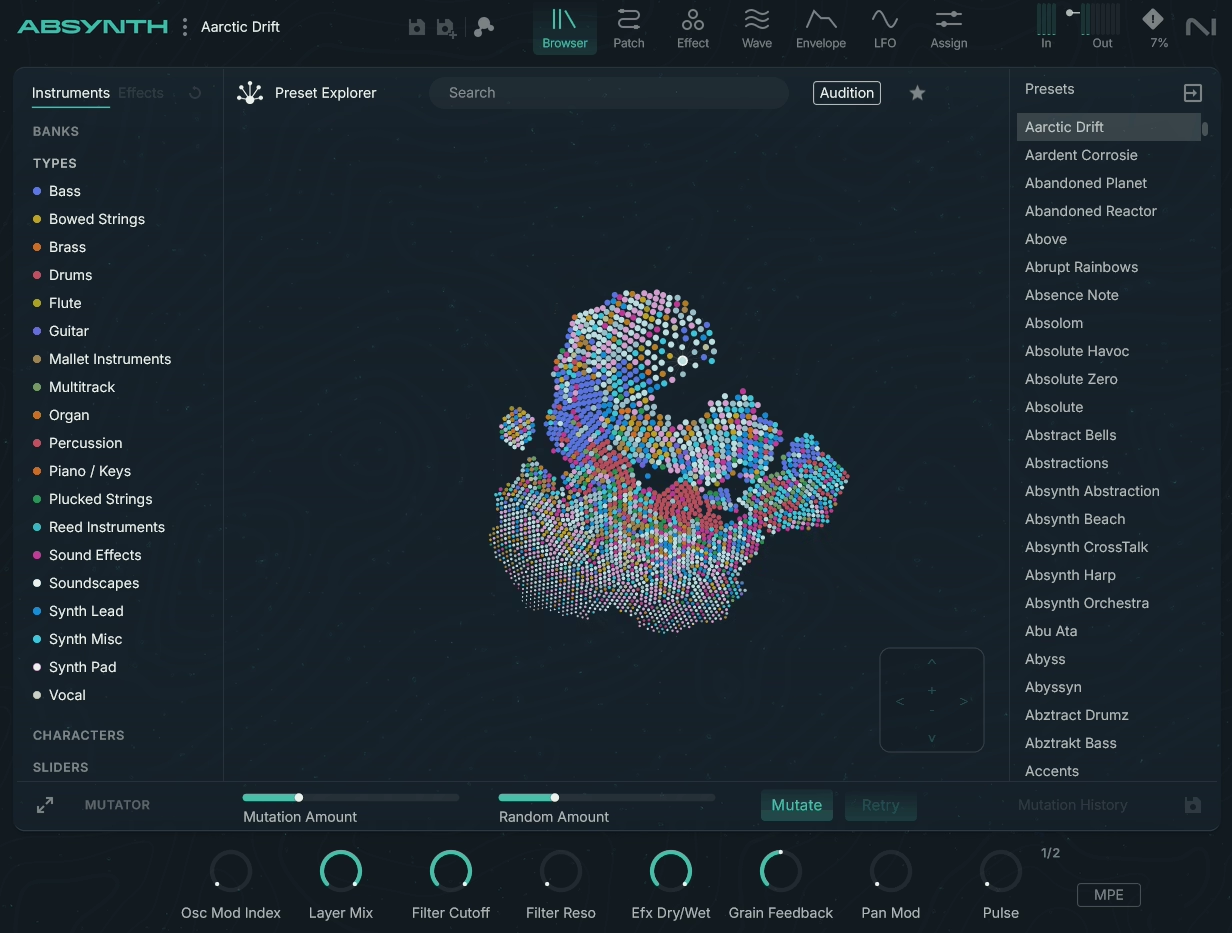
The AI Preset Explorer maps more than 2,000 factory sounds onto a visual timbral landscape for browsing by character rather than name. Contributions from Brian Eno, Kaitlyn Aurelia Smith and Richard Devine are included, alongside backward-compatible legacy patches from every previous Absynth release.
2. Arturia Pigments 7 (Wavetable, Sample, Granular, Modal, Harmonic, Virtual Analog)
- Compatibility: Windows/macOS
- Format: VST2/VST3/AU/AAX
What keeps Arturia Pigments 7 ahead of most competing multi-engine synths is the combination of six synthesis types, a thoughtfully organised interface, and a free-upgrade policy that has held firm through every major release.
Virtual analog, wavetable, harmonic additive, granular, sample and physical modelling engines load in pairs through a twin-engine architecture, letting you create hybrid patches that draw from two different worlds simultaneously.
The v7 filter refresh introduces Rage (distortion algorithms embedded directly inside the filter feedback loop for per-voice polyphonic saturation), Ripple (phase-shifted resonant peaks for formant movement), and Reverb (spatial processing integrated into the filter path for bass reinforcement).
A Corroder module applies frequency-selective bit-crushing to isolated bands. S-curve amplitude envelopes tighten attacks, and internal optimisations lower CPU demand on dense patches.
Colour-coded drag-and-drop modulation with depth rings reading in semitones, a generative sequencer with arpeggiator, and 20 effect algorithms give you production and performance tools that many standalone processors would struggle to match.
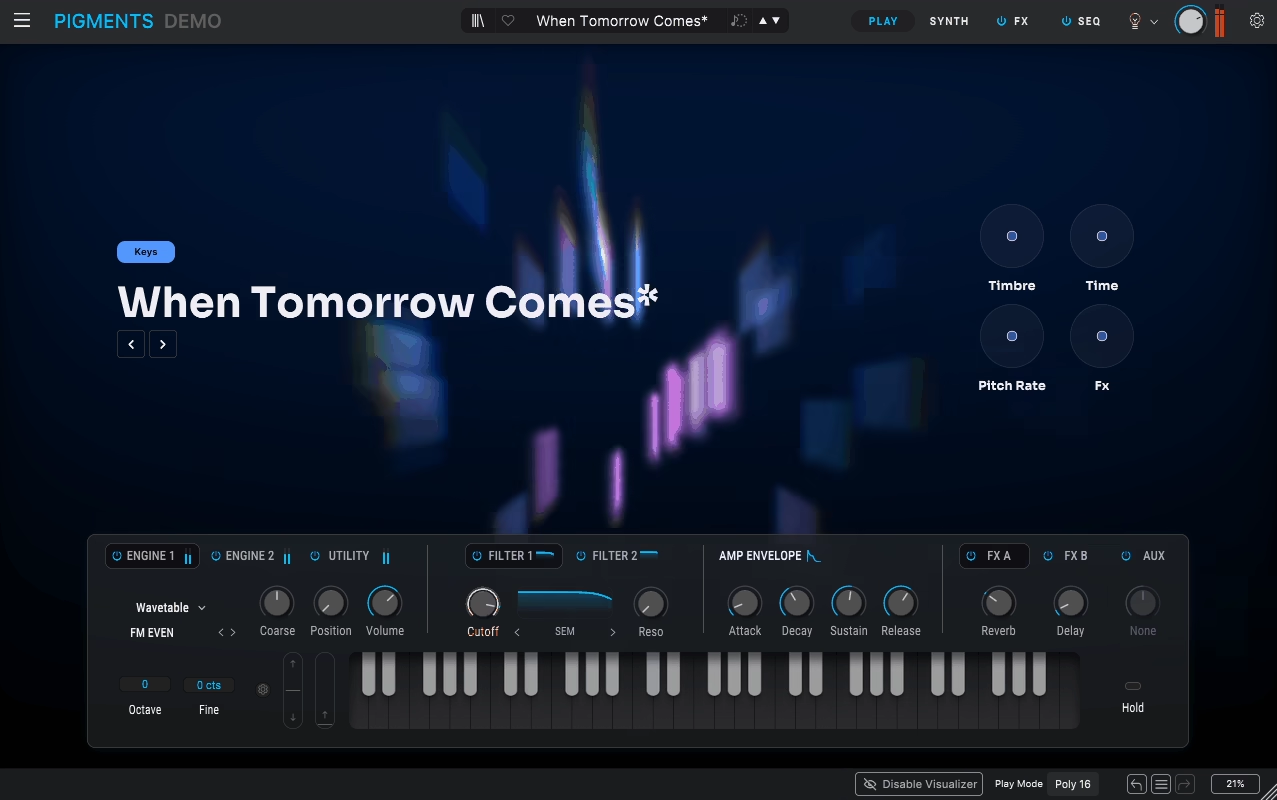
The audio-reactive Play View surfaces circular macro controls for quick preset shaping. 1,700+ presets now span the complete library across seven versions, with the latest adding 150 patches, 50 wavetables, 30 samples and 20 noise sources plus interactive sound design walkthroughs accessible directly from the browser.
3. KORG opsix native (Subtractive, Semi-Modular, Analog, Waveshaping, Additive, FM)
- Compatibility: Windows/macOS
- Format: VST3/AU/AAX/Standalone
The hardware opsix earned a reputation for making FM synthesis approachable by expanding each operator beyond traditional frequency modulation into eight distinct functional modes. KORG opsix native brings that Altered FM engine into a full-screen plugin environment where deep parameter editing no longer means squinting at a compact hardware display or navigating nested menus.
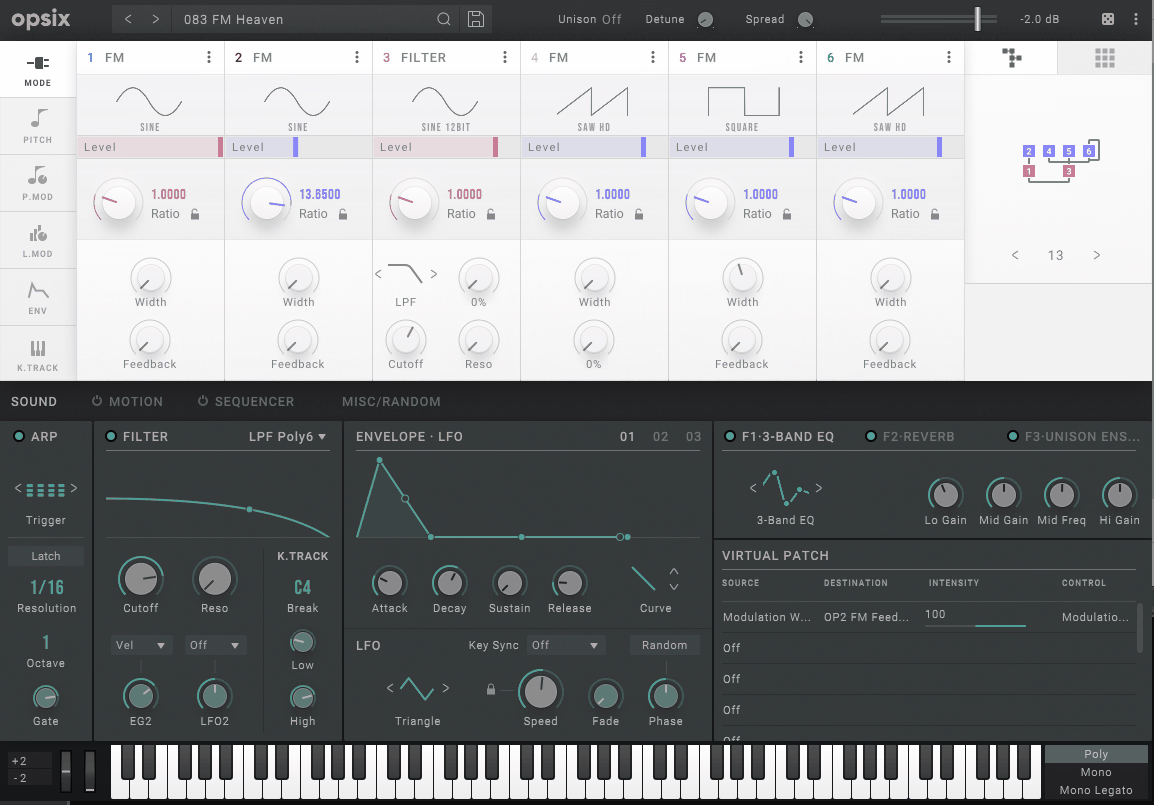
Six operators support standard FM, ring modulation, filter, filter FM, wavefolder, effect, bypass and mute modes, with 21 waveforms per operator spanning multiple sine resolutions, analog-style shapes, eleven additive options and noise. Forty preset algorithms plus a user-definable forty-first handle operator routing.
The combined flexibility of these modes means opsix naturally spans subtractive, analog modelling, waveshaping, additive and semi-modular synthesis territory alongside its FM foundation, all from a single plugin.
Independent modulation resources include three envelope generators, three LFOs and 12 virtual patch connections for routing to a wide target list. Analog-modelled MS-20 and PolySix filter types from KORG’s hardware lineage sit alongside standard multi-pole designs.
Ninety effects across three parallel processing banks, a polyphonic step sequencer, built-in spectrum analyser, oscilloscope and a randomisation tool that can target individual parameter groups or scramble everything at once complete the package. Full patch transfer between the hardware and software ensures that sounds travel freely between studio and stage.
4. Minimal Audio Current 2 (Wavetable, Granular, Sample-based)
- Compatibility: Windows/macOS
- Format: VST2/VST3/AU/AAX
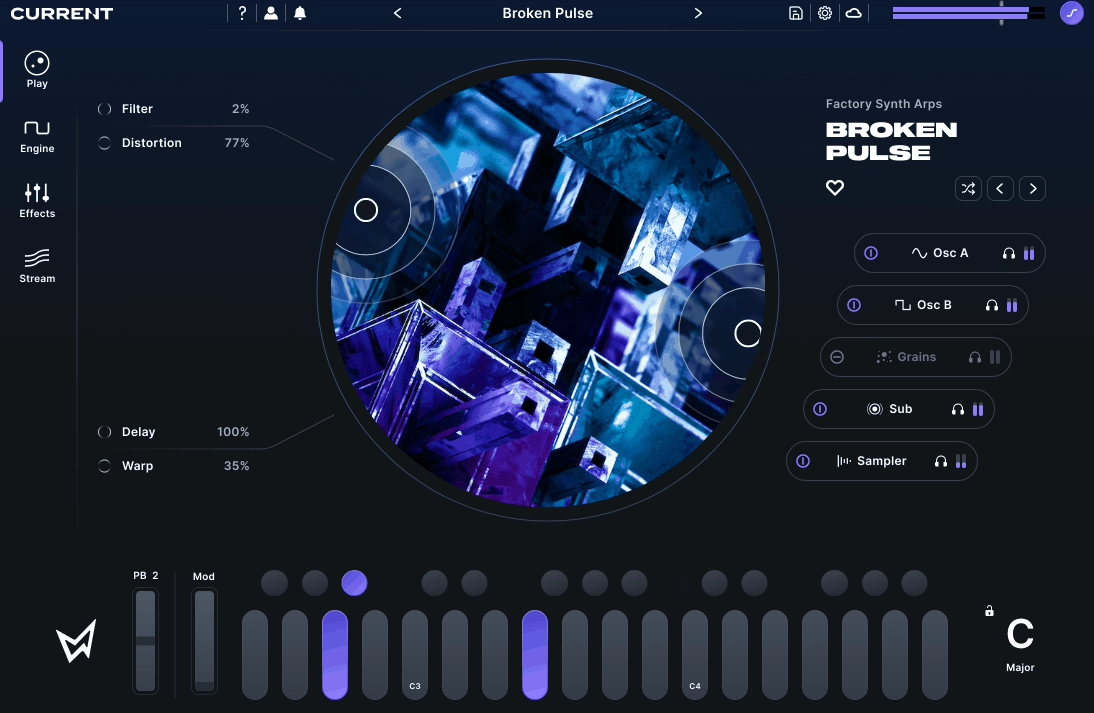
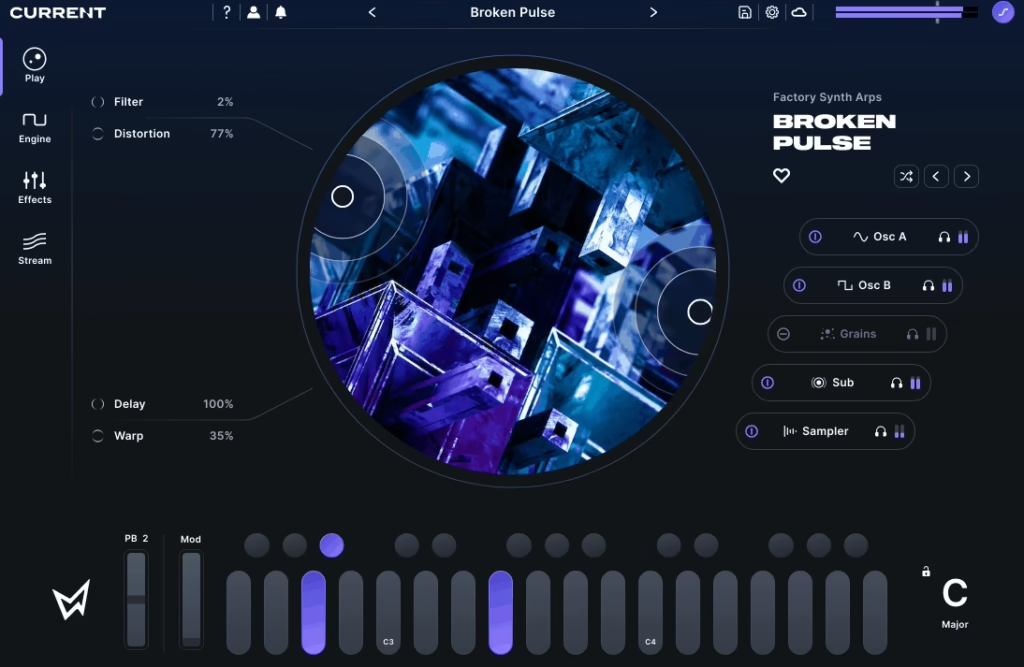
The philosophy behind Minimal Audio Current 2 becomes clear the moment you open the effects section: nine slots loading full, uncompromised editions of Rift, Cluster Delay and the v2-exclusive Wave Shifter, positioned not as finishing touches but as equal creative partners to the oscillators. That approach to effects as first-class sound design tools is what distinguishes Current 2 from other instruments in this category.
Paired spectral wavetable generators, a granular processor, a time-stretching sampler and a harmonic additive sub oscillator form the sound engine. Wave Shifter blends frequency shifting with FM, AM and ring modulation to produce metallic, glitchy tones that standard effect chains rarely approach.
More than 50 filter modes cover morphing, vowel, comb and conventional responses with gain-compensated series or parallel routing, and FM plus AM cross-modulation between engines extends the harmonic vocabulary further.
Drag-and-drop modulation links nine assignable sources (LFOs, envelopes, curve sequencers, audio followers, MIDI controllers) to any target without connection limits.
A matrix overview reveals every active route at once. The engine mixer supports per-source soloing and balance, a Play View provides dual XY pads mapped to four macros, and the built-in Stream browser delivers ongoing content. Factory stock includes 400+ presets, 170+ wavetables and 800+ samples with 32-voice polyphony.
5. LANDR Synth X (Wavetable)
- Compatibility: Windows/macOS
- Format: VST3/AU/AAX
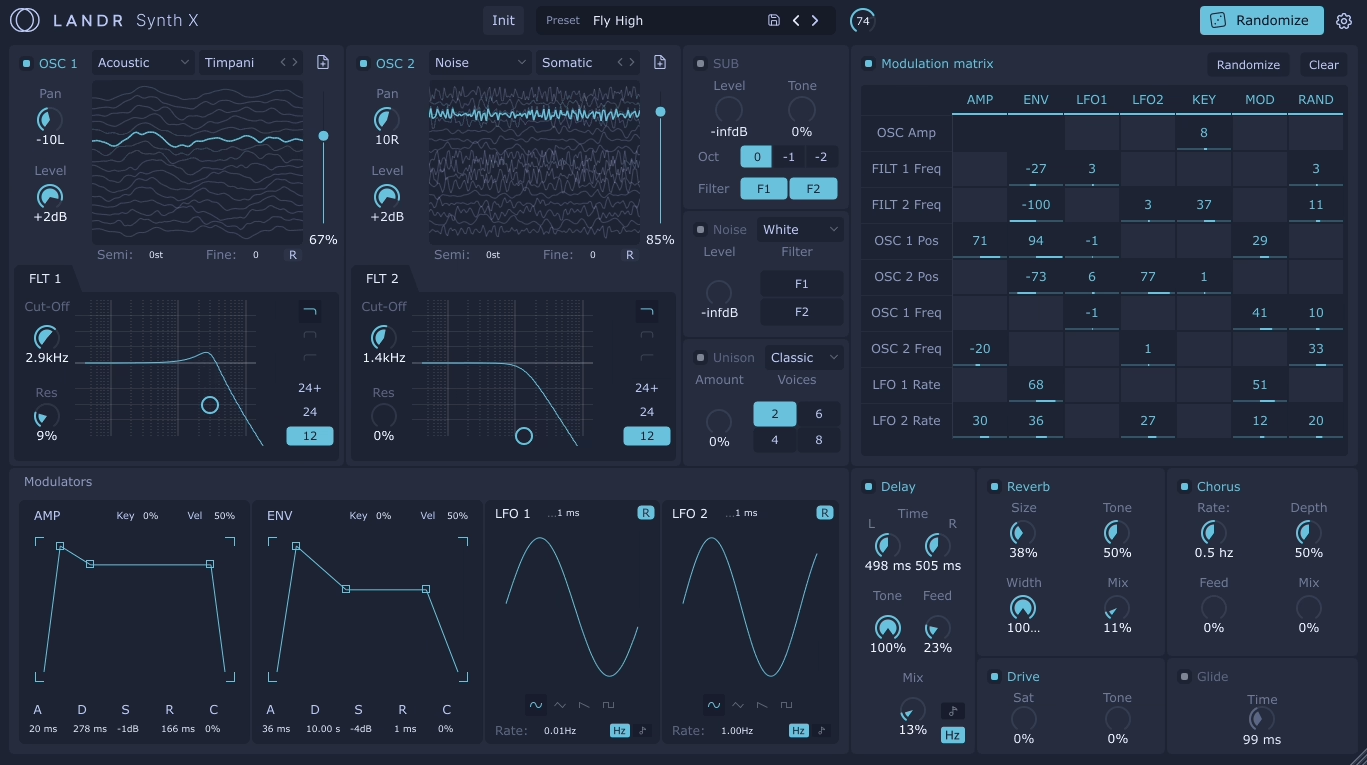
Depth is only valuable when you can access it quickly, and that is the design principle LANDR Synth X is built around. Every essential control for wavetable synthesis sits on a single visible panel: ADSR shaping, LFO modulation and a full routing matrix, all without tabs or hidden sub-menus. The result is a plugin that rewards speed without forcing you to trade away the tools that matter for genuine sound design.
Custom wavetable import lets you drag audio straight into the instrument and convert it into a playable table, opening a direct path to building unique sounds from your own recordings. Reverb, delay, saturation and chorus are built in, providing enough processing to take a patch from raw waveform to finished sound without external help. A one-click Randomize button generates fresh patches instantly for those moments when inspiration runs dry.
400 presets and 100+ wavetables cover electronic, ambient and pop-leaning ground out of the box, and the optimised engine handles multiple simultaneous instances without taxing modern systems. Synth X works equally well as the only wavetable plugin in a beginner’s collection or as a fast-access sound generator sitting alongside more complex instruments in a seasoned producer’s toolkit.
6. Roland Zenology Pro (Huge Preset Library)
- Compatibility: Windows/macOS
- Format: VST3/AU/AAX
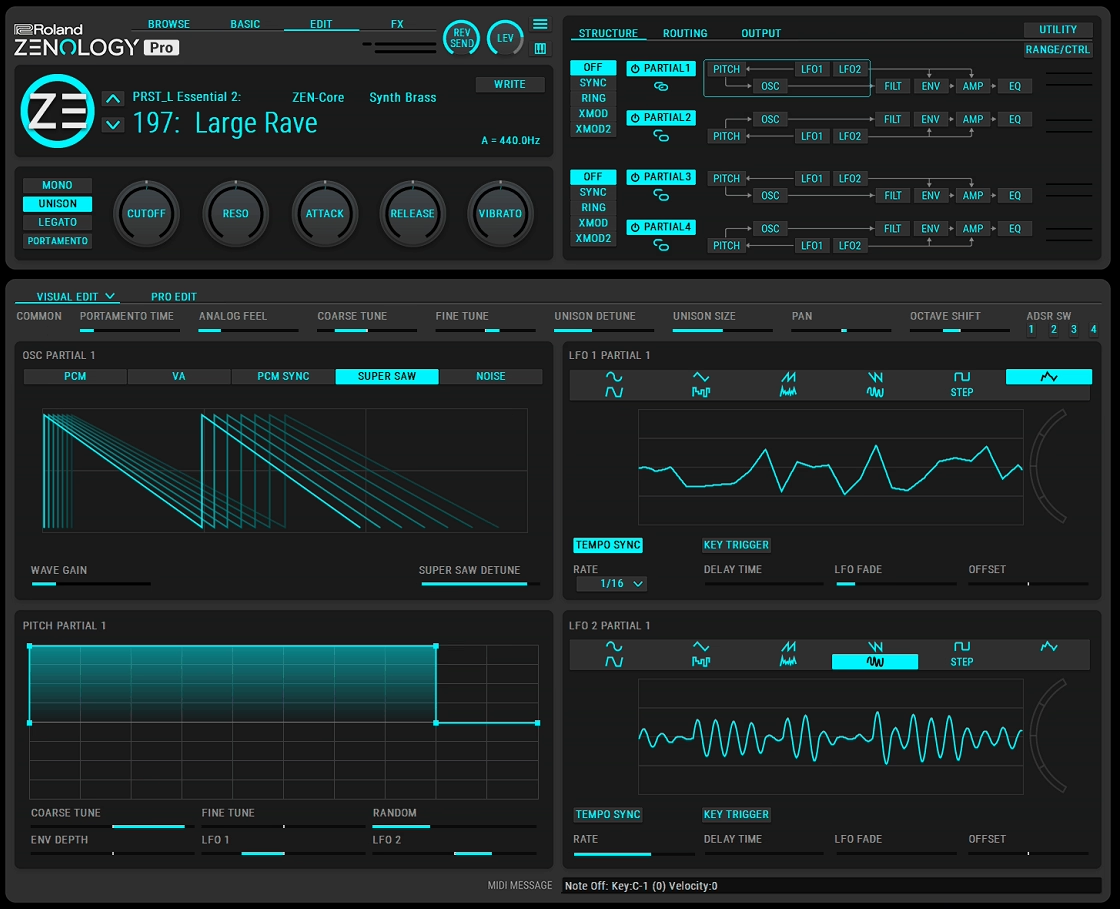
Behind every patch in Roland Zenology Pro sits the ZEN-Core Synthesis System, the same architecture driving the Jupiter-X and Fantom hardware lines and carrying the accumulated knowledge of five decades worth of Roland instrument engineering. For producers who prioritise having a massive, production-ready sound library instantly available over building patches from scratch, this is one of the strongest options on the market.
Up to four partials per patch provide the foundation. Each partial houses an oscillator drawing from thousands of PCM waveforms or virtual analog shapes, a multimode filter, an amplifier and dual step LFOs. Partial pairing through sync, ring modulation and cross modulation creates layered and animated textures, and filter emulations from various Roland hardware designs add authentic character.
Model Expansions elevate the plugin beyond a general-purpose preset browser by turning it into faithful recreations of the JUNO-106, JUPITER-8, JD-800, JX-8P and SH-101, each featuring its own dedicated panel mirroring the original hardware layout.
Expandable content through Roland Cloud pushes the total selection past 10,000 patches. Ninety onboard effects featuring classics such as the SDD-320 Dimension D and CE-1 chorus, an arpeggiator with full DAW automation, and seamless patch transfer between the plugin and compatible Roland hardware round out a package that bridges the studio and the stage.
7. Xfer Records Serum 2 (Wavetable, Sample, Granular)
- Compatibility: Windows/macOS
- Format: VST3/AU/AAX
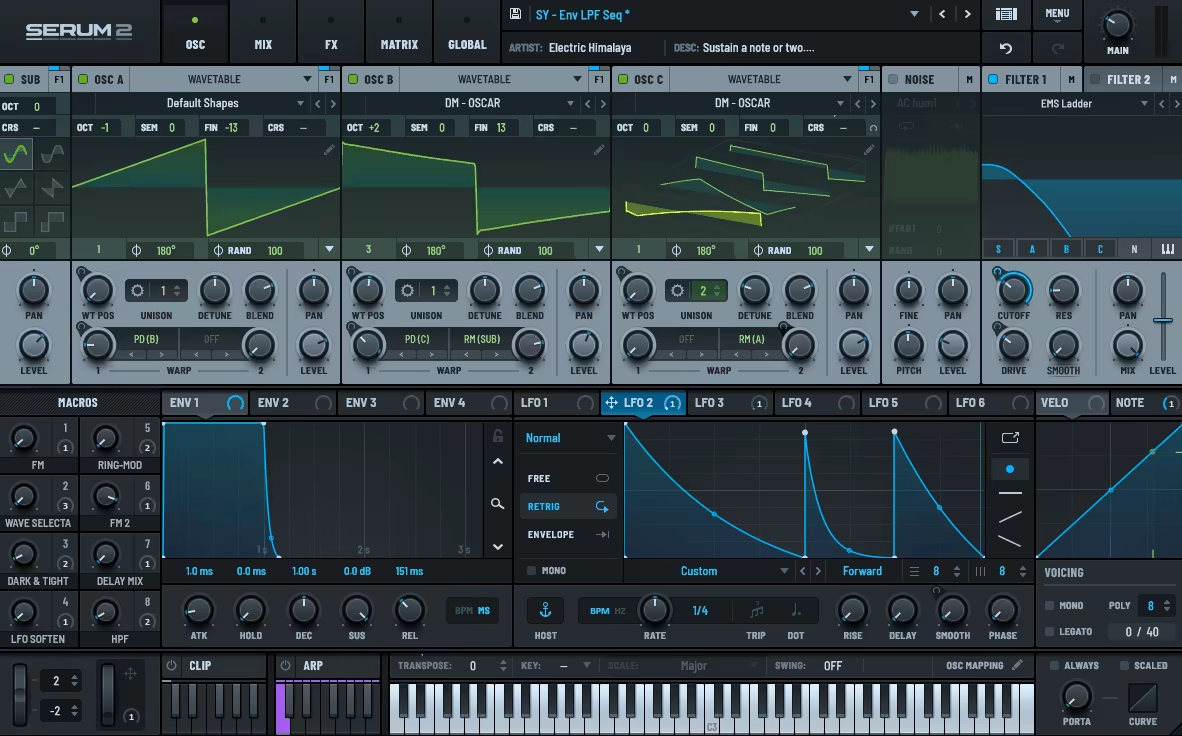
No plugin in the past decade shaped the landscape of electronic music production as thoroughly as the original Serum, and its successor does not simply refine the formula. Xfer Serum 2 rebuilds the architecture into a five-engine hybrid spanning wavetable, granular, spectral, sample and multisample modes, all loadable across three oscillator slots that can each switch between any engine type independently.
A dedicated sub oscillator anchors the bottom end, and the inclusion of factory acoustic recordings in SFZ format lets you layer real piano, string and guitar textures with synthetic processing inside a single patch.
Dual warp functions and phase distortion expand the wavetable engine. Filter additions include MG Ladder, Acid Ladder and a fully drawable custom response editor. Ten LFOs incorporating Lorenz and Rössler chaos generators, four tempo-lockable envelopes and visual drag-and-drop assignment handle modulation.
Dual independent FX buses allow stacking multiple copies of the same processor, and a convolution reverb with factory impulse responses broadens the spatial toolkit.
An integrated 32-step arpeggiator and clip sequencer for composing MIDI directly within the synth add songwriting capabilities alongside the sound design features. 626 factory presets and 288 wavetables ship with the instrument.
Original Serum owners receive the complete upgrade at no extra charge, which effectively makes version 2 the most generous major synth update in recent memory.
8. GForce Halogen FM (FM)
- Compatibility: Windows/macOS
- Format: VST/VST2/VST3/AU/AAX/Standalone
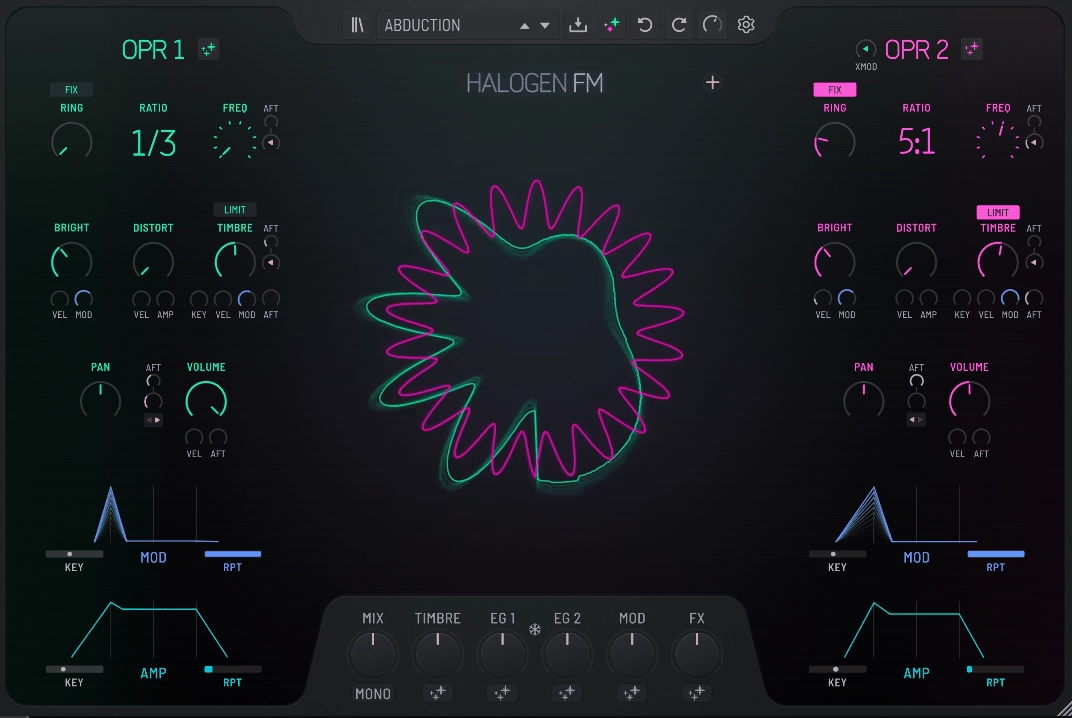
Producers who have bounced off FM synthesis because of its reputation for impenetrable complexity will find a very different experience waiting inside GForce Halogen FM. By reducing the architecture to two operators and centering the workflow around a generative Spark engine, GForce removes the barriers without removing the sonic richness that makes FM worth pursuing. Drawing on an obscure Japanese FM instrument for its core design, Halogen FM is also the company’s first entirely original synth after years building its name through meticulous Oberheim emulations.
One press of the global Spark button produces a complete, musically coherent patch from nothing. Six macros covering timbre, envelopes, modulation and effects let you refine the output with minimal effort. Individual Spark buttons per operator allow selective randomisation so you can lock elements you like while regenerating the rest.
Underneath the generative layer sits full manual access to per-operator distortion, brightness, ring modulation and timbre controls, dual envelope generators with key tracking and adjustable looping, and a multi-waveform LFO with broad routing options.
Mono and polyphonic modes, polyphonic aftertouch, pitch-bend and an atmospheric reverb with size, density, filter and modulation parameters are all included. 320 factory presets cover a range of FM territory.
A colour-coded visual display tracks operator interaction in real time, and comprehensive MIDI CC mapping makes the instrument ready for hands-on live performance.
9. Dawesome Abyss by Tracktion (Visual, FM)
- Compatibility: Windows/macOS
- Format: VST3/AU
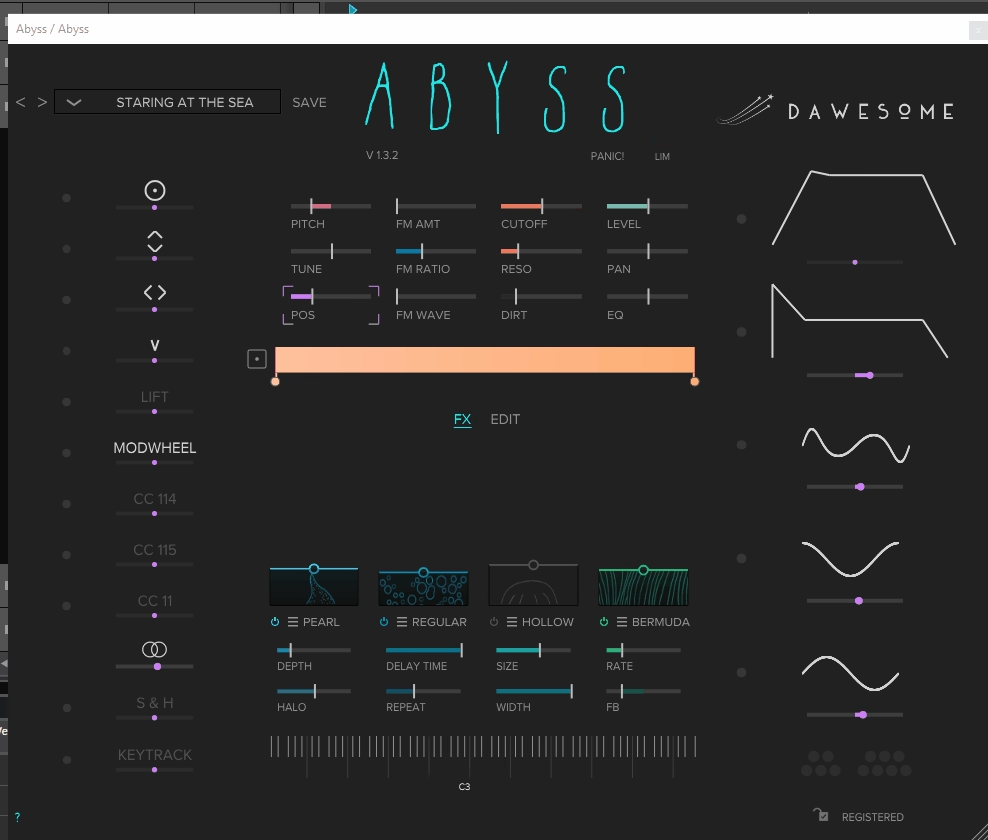
Imagine a synthesizer where you pick sounds by colour instead of scrolling through oscillator types, where morphing between timbres means dragging hues across a gradient bar, and where the effects look like ocean creatures rather than knobs and sliders. That is Dawesome Abyss, the creation of mathematician and musician Peter V, and there is genuinely nothing else like it on the plugin market.
Over 2,000 tone colours, each representing a unique sonic texture, can be selected visually and placed onto a gradient strip. The engine then morphs between those textures through manual sweeps, internal modulation or hardware controller input.
Underneath the colour interface, a hybrid engine merges processed acoustic samples with conventional synthesis. The themed effects section uses bubbles for delay, a jellyfish for reverb, a sea creature for shimmer and waves for the phaser, but the processing itself is capable and musical despite the whimsical presentation.
Dual ADSR envelopes and three LFOs with custom waveshapes, flip, divide and polyphonic capability handle modulation.
Two LFOs additionally function as scale-quantised step sequencers, and every modulation source can reach the tone colour parameters directly, letting you automate the fundamental character of your sound rather than just peripheral controls. MPE support adds per-note expression for compatible hardware.
300+ presets lean toward ambient pads, cinematic drones and textural atmospheres, positioning Abyss as a specialist tool for producers who work in moods and soundscapes rather than traditional melodic structures.
10. Expressive E Noisy 2 (MPE Soft Synth)
- Compatibility: Windows/macOS
- Format: VST2/VST3/AU
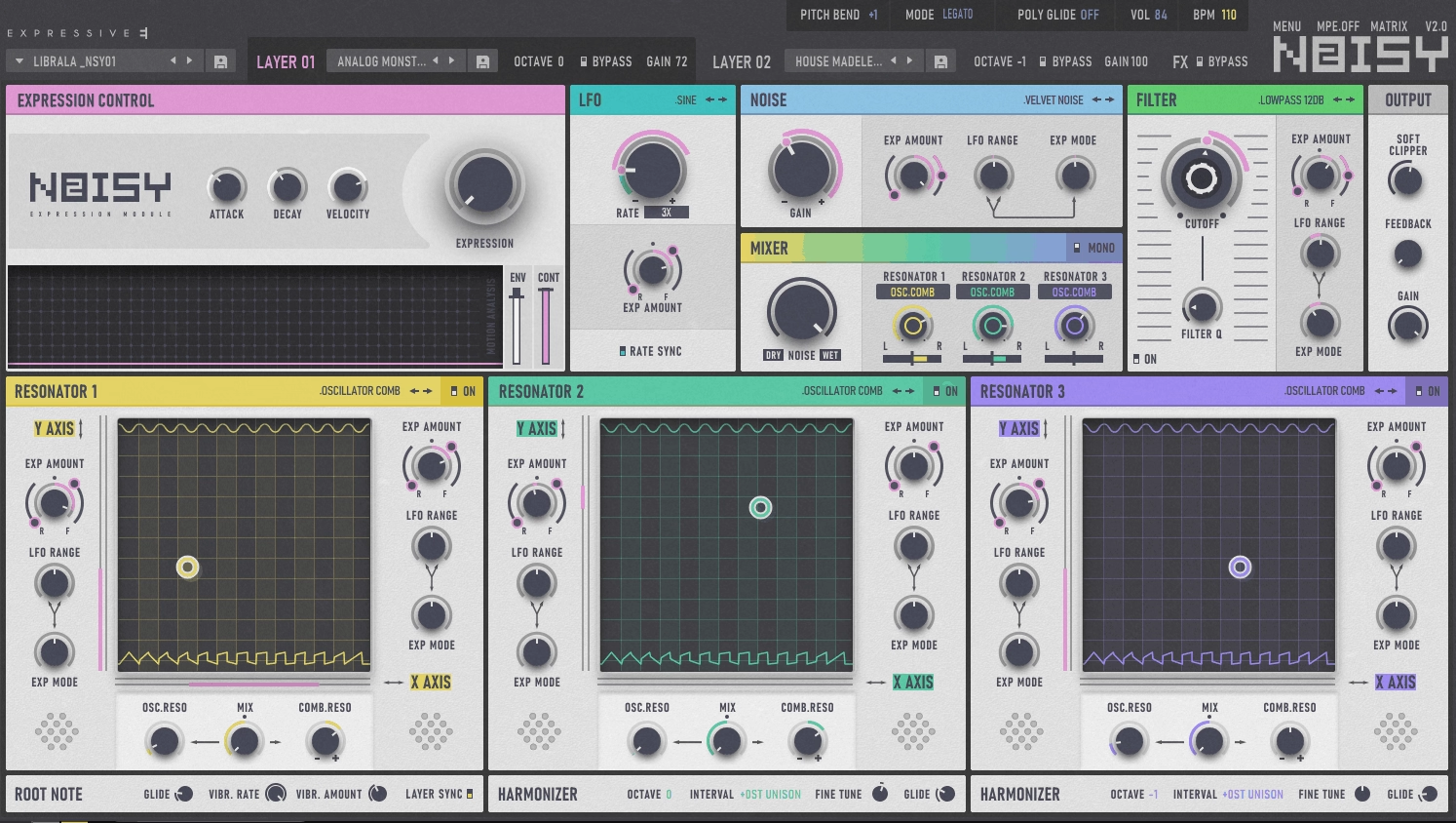
Most plugin synths that advertise MPE compatibility simply mapped a few extra parameters to channel pressure and called it done. Expressive E Noisy 2 takes a fundamentally different path because it was conceived by the same team that built the Osmose keyboard and the Touche controller, meaning gestural expression is baked into the synthesis architecture itself rather than layered on top of something that was designed for standard MIDI.
Sound generation starts with 21 noise sources exciting seven resonator types: four acoustic modals, an oscillator-comb hybrid for blown pipe and bowed string timbres, a PWM analog resonator and subtractive comb filters.
Two bi-timbral layers each accommodate up to three resonators simultaneously, with pitch offsets reaching six octaves and polyphonic glissando available per resonator. Version 2 adds four additional filter emulations and a feedback-loaded soft clipper to the multimode filter on each layer.
Trig Modes introduce gesture-driven envelope control that no other plugin currently offers. Push (downward acceleration), lift (upward movement) and shake (alternating direction) activate envelope impulses at any moment during key travel, not only at note onset. Four expression blocks replace standard ADSR envelopes with granular control over how pressure, aftertouch and internal generators interact with sonic parameters.
Dual FX slots, stereo delay and plate reverb respond dynamically to gestures. The 1,200-preset library splits between 500 MPE-optimised and 700 conventional MIDI patches, with certified compatibility for Osmose, Touche, Push 3, Seaboard and Linnstrument.
11. FabFilter Twin 3 (Subtractive, Analog)
- Compatibility: Windows/macOS
- Format: VST/VST3/AU/AAX
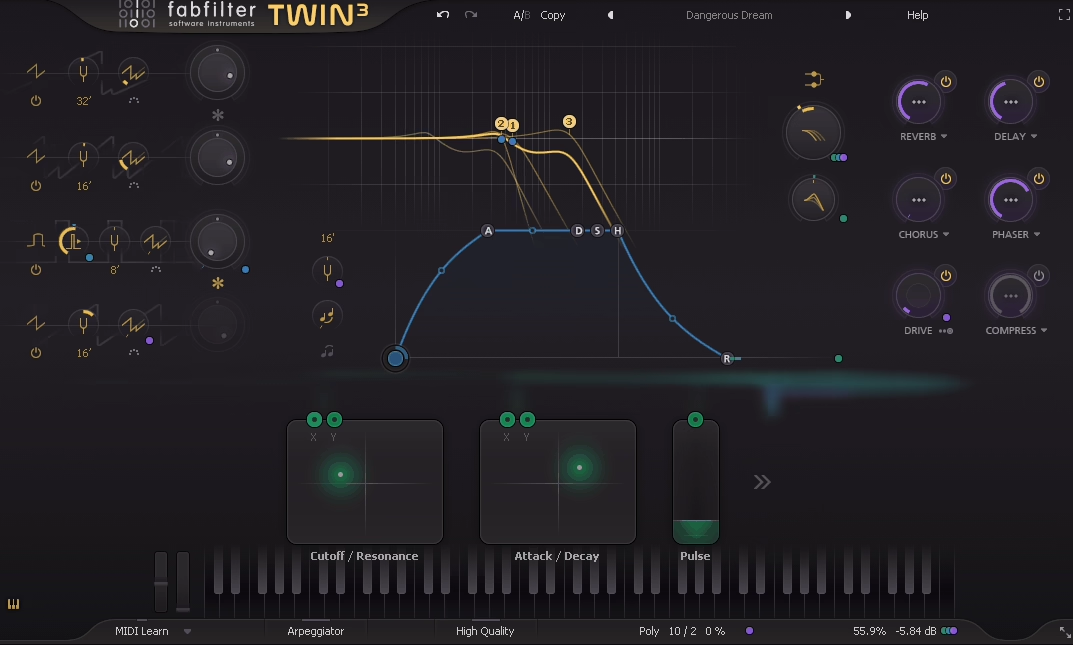
Subtractive synthesis is the oldest and most widely understood form of sound generation in the synth world, which makes it tempting to assume there is nothing left to innovate. FabFilter Twin 3 proves otherwise by applying the same interface philosophy that turned Pro-Q and Pro-L into studio standards: give producers powerful tools and make using them feel effortless.
Three oscillators with continuously morphable waveforms spanning sine through sawtooth through square, sub and noise generators, sync, FM and pulse-width modulation provide the raw sound sources. FabFilter’s analog-modelled filters deliver multiple types with adjustable slopes, drive, panning and serial, parallel or per-voice configurations. Unison with spread, detune and pan controls builds width.
Sixteen modulation sources (LFOs, envelopes, step sequencer, MIDI, XY pad) connect to any target through drag-and-drop with visual depth rings per assignment. A full matrix view reveals every active route at once, ensuring that even the most heavily modulated patches remain completely legible. Delay and reverb with their own modulation inputs handle final shaping.
Rather than chasing the multi-engine trend, Twin 3 commits to subtractive synthesis with exceptional fidelity and an interface that never stands between you and the sound you are hearing in your head.
12. Universal Audio Opal (Morphing)
- Compatibility: Windows/macOS
- Format: VST3/AU/AAX
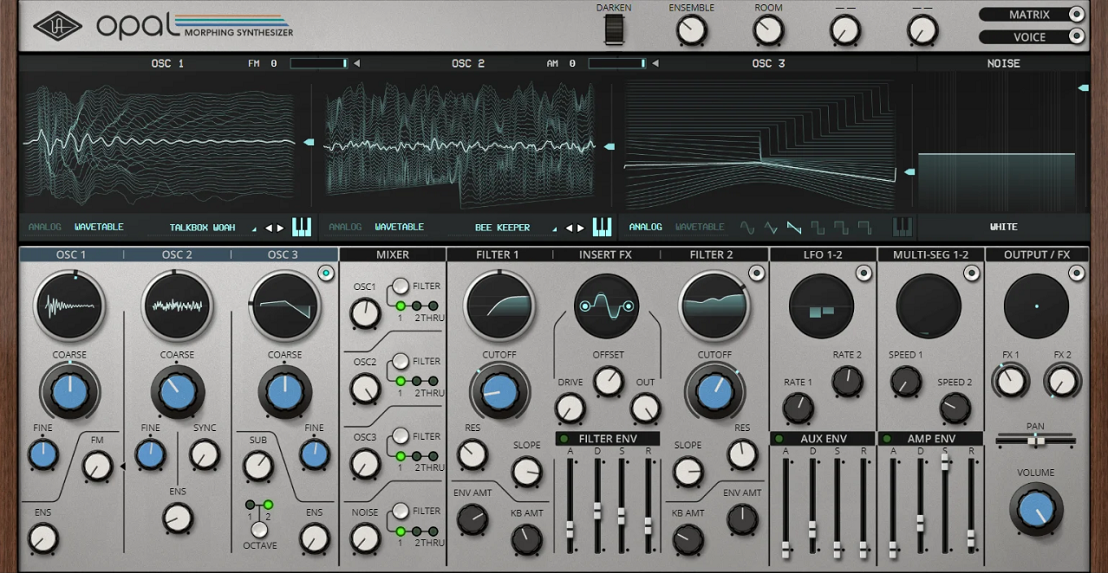
Most synths force you to pick a filter type, and that is the filter you get until you switch to another one. UAD Opal Morphing Synthesizer does away with that limitation entirely. Both of its multimode filters transition fluidly and continuously through low-pass, band-pass, high-pass and notch modes in an unbroken loop, generating smooth tonal sweeps that traditional stepped controls cannot reproduce no matter how quickly you automate them.
Three oscillators operate in analog modelling or wavetable playback using 91 factory tables spanning digital, synth, complex, vocal and instrument categories. FM on oscillators one and two, AM on oscillators two and three, and a hidden-source sync on oscillator two for hard sync tones without dedicating an extra slot provide harmonic depth. Per-oscillator ensemble controls stack detuned copies for width, with 12-voice polyphony.
Insert and output processors drawn directly from Universal Audio’s professional studio catalogue load modelled vintage spring reverb, tape delay, modulation effects and the 1176 compressor with its iconic all-buttons-in mode. These are genuine studio-grade tools, not watered-down synth versions.
The plugin operates natively without UA hardware. User wavetable import is not supported, a notable gap for producers who build custom table libraries, although the curated factory selection covers a wide enough range to keep most sessions well supplied.
13. Kilohearts Phase Plant (Semi-Modular, Wavetable, Sample-based, Analog)
- Compatibility: Windows/macOS
- Format: VST3/AU/AAX/CLAP
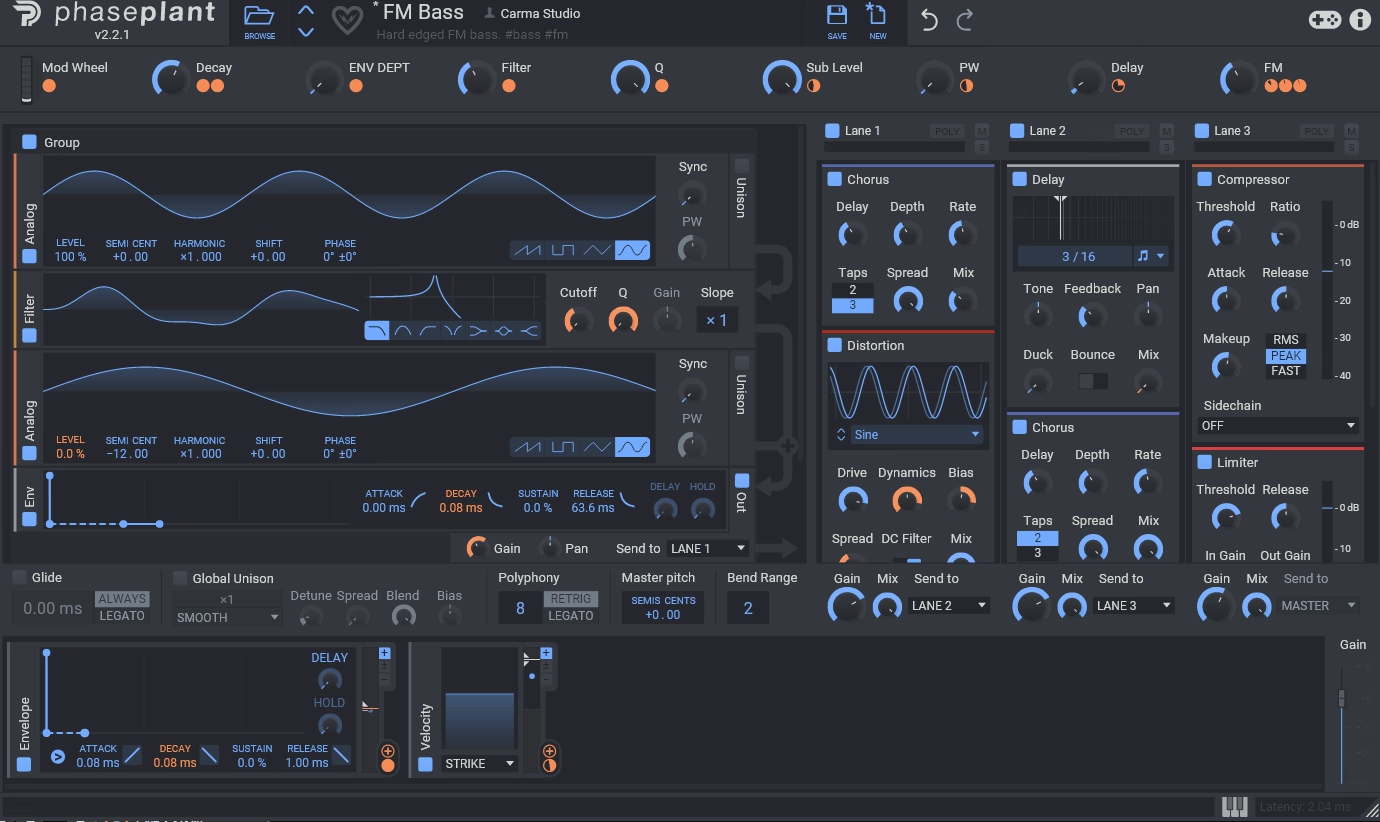
Where every other instrument on this list presents you with at least some pre-built structure, Kilohearts Phase Plant starts you with a completely bare workspace and the freedom to construct whatever you can imagine. Wavetable oscillators, analog generators, sample players, noise sources, filters and effects all drop in on demand, grouped into independent lanes with their own dedicated processing chains. The architecture places no fixed limits on patch topology, which means two users can build fundamentally different instruments inside the same plugin depending on how they choose to route things.
Kilohearts Snapins serve as the effects modules, and these are the exact same processors available individually across the company’s ecosystem (Disperser, Multipass, Faturator, Slice EQ and others). Purchasing any Snapin outside Phase Plant automatically expands what the synth can do internally, creating a modular collection that grows over time.
The poly toggle remains Phase Plant’s most celebrated feature: activating it gives each polyphonic voice its own independent effects chain rather than routing all voices through shared processing. A chord played through a per-voice delay drifts differently on every note. A random modulator applied per-voice stamps unique qualities onto each key press. LFOs, envelopes, MIDI controllers and macros connect to everything via drag-and-drop.
Phase Plant demands more upfront learning than fixed-architecture synths and rewards patch builders far more than preset browsers, but for producers who want total creative control over signal flow, it stands in a class of its own.
14. Klevgrand Tomofon (Resynthesis, Wavetable-style Morphing)
- Compatibility: Windows/macOS
- Format: VST/VST3/AU/AAX
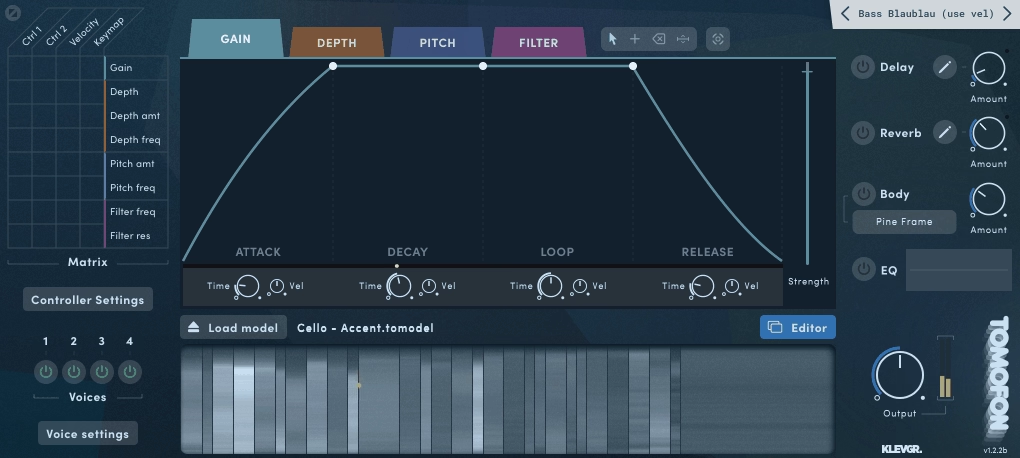
Calling Klevgrand Tomofon a sampler would be inaccurate, and calling it a conventional wavetable synth would miss the point entirely. The Swedish developer designed this instrument around a proprietary Audio Model system that analyses monophonic audio, slices it into discrete waveform cycles, sorts those cycles by pitch, and distributes them across the keyboard as interconnected wavetable groups. What comes out is a playable instrument carrying the tonal fingerprint of its source material without ever simply playing back a recording.
The Depth parameter scans through waveform layers within each pitch zone, and automating it with envelopes or LFOs produces organic timbral changes that conventional wavetable morphing cannot easily match.
Merging several audio files combines the harmonic properties of different instruments into hybrid sources, letting you fuse a trumpet with a human voice or blend a cello sustain with a field recording into something entirely new.
Four polyphonic voices with individual pitch, modulation and pan controls form the playback core. Gain, depth, pitch and filter cutoff each have dedicated ADSR envelopes with loopable sustain stages that create cyclic LFO-style movement without needing additional modulators. A resonant ladder filter with drive adds subtractive shaping.
Delay, reverb and EQ processors sit at the output stage. A mod matrix supporting two assignable controllers, velocity sensitivity and key mapping provides performance flexibility, and MPE compatibility turns the instrument into something especially expressive when paired with gesture-based controllers. 124 Audio Models and 180+ presets spanning strings, vocals, brass, woodwind and guitars make up the factory library.
Hello, this blog is about more than just chorus, bass and synths. In fact, I started it to cover best VST plugins and Kontakt libraries, so you have easier time finding the right tools and instruments for your music production needs, mixing, as well as mastering. New tools and instruments are constantly evolving and need to get in front of audience, because even some of the best brands like Antelope Audio aren’t talked about enough – that’s what I want to change. I want to promote plugins that are less known but are perfectly relevant for certain topics.