
Analog synth plugins have improved dramatically in the past few years. Circuit modelling technology now recreates individual electronic components rather than simply imitating the output signal, which means the latest generation of virtual instruments can capture the drift, saturation and filter behaviour that give real hardware its distinctive sonic character.
Several of the plugins on this list come from the original hardware manufacturers or are developed in direct partnership with them, adding a level of authenticity that earlier software generations couldn’t match.
We’ve focused on eight instruments that cover different corners of analog synthesis, from monophonic Minimoog emulations and ARP Odyssey recreations to original designs inspired by decades of classic hardware.
Each one brings something different to the table, and all of them deliver the kind of organic, responsive tone that keeps producers reaching for analog-style sounds in the first place.
1. KORG ARP Odyssey
- Compatibility: Windows/macOS
- Format: VST3/AU/AAX
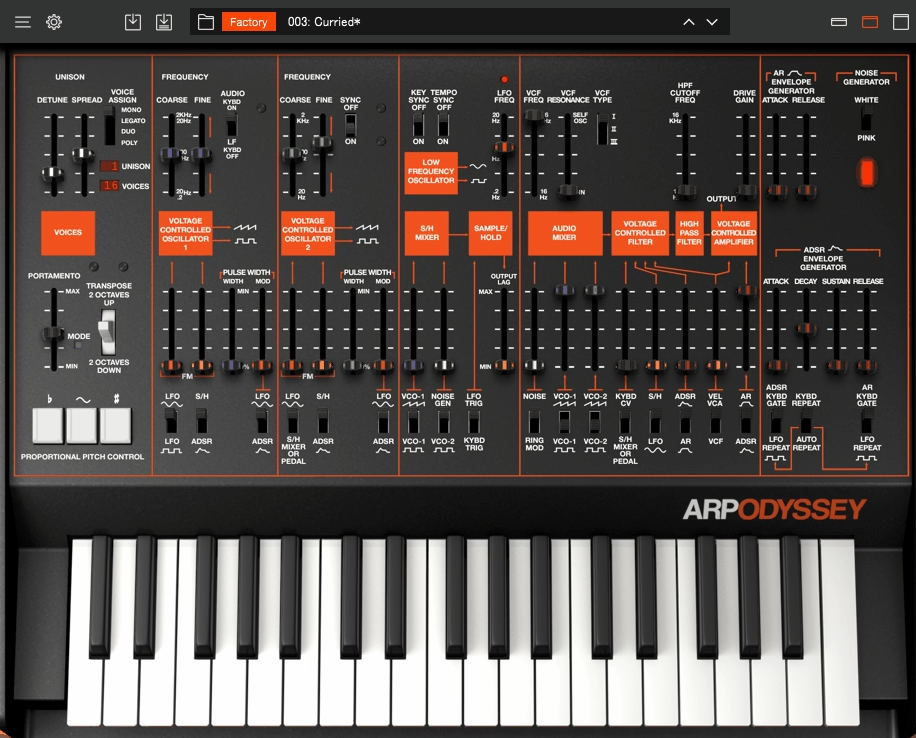
David Friend co-founded ARP Instruments and designed the Odyssey in 1972, and when Korg decided to revive the hardware more than four decades later, Friend was directly involved in making sure the reissue matched the original. KORG ARP Odyssey in plugin form benefits from that same scrutiny. Korg didn’t model the Odyssey by ear or from schematics alone; they used their CMT (Component Modeling Technology) to digitally recreate each physical electronic part and wire them into the identical circuit layout as the original instrument.
What this means in practice is that the plugin doesn’t just approximate the Odyssey’s general character at commonly used settings. It responds with the same nuance at the extremes, where hard sync gets nasty, where the sample-and-hold modulation creates unpredictable textures, where pushing resonance on the filter produces that unmistakable ARP howl.
Three generations of filter design live inside the plugin, selectable with a single switch. The earliest Mk I revision used a two-pole topology with a brighter response, while the Mk II moved to a four-pole circuit with characteristics reminiscent of Moog’s filter work.
The Mk III introduced ARP’s proprietary 4075 design, landing somewhere between the other two. Visually, the interface switches to match the corresponding era’s panel colour scheme: white for Mk I, black-and-gold for Mk II, and the famous black-and-orange for Mk III.
On the modern side, Korg expanded the original’s duophonic voicing to 16-voice polyphony with stackable unison, added a programmable arpeggiator with sequencer-like step control, and packed in an effects unit and 200 factory patches. The interface could use a resolution update for modern monitors, but the sonic accuracy makes that a minor complaint.
2. UAD Anthem
- Compatibility: Windows/macOS
- Format: VST3/AU/AAX
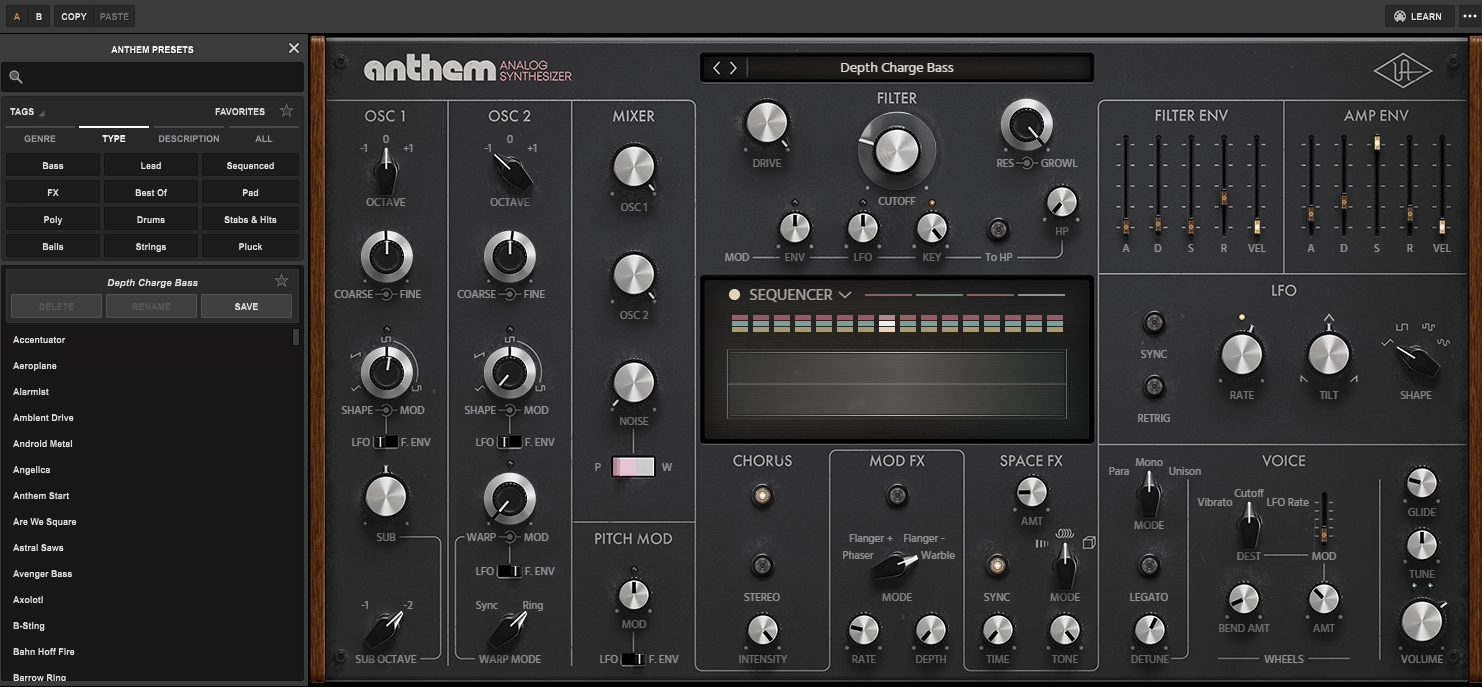
It would have been easy for Universal Audio to emulate another specific vintage monosynth. The market is already full of those. UAD Anthem takes a more interesting route by absorbing the essence of an entire era of classic hardware and distilling it into a single, focused instrument that isn’t beholden to any particular design.
Two continuously shapeable oscillators combine with a sub and noise generator to feed a low-pass filter built around four tightly linked controls: Cutoff, Resonance, Drive and Growl. It’s the Growl parameter that really sets this apart from stock DAW synths and their vanilla filter sections. At subtle settings it adds harmonic warmth; pushed further, it introduces an abrasive, snarling quality that gives bass lines and leads an unmistakable weight. Paraphonic voicing means chords are possible but filtered and shaped as one signal, exactly the way many celebrated mono-oriented hardware synths handled polyphony.
Chorus, flanger, spring reverb and tape echo sit in the effects section, each modelled with enough analog character that they feel like part of the instrument rather than tacked-on extras. An integrated step sequencer brings rhythmic patterns, accent variation and generative movement to patches without any external tools required.
Anthem runs natively across Mac and Windows systems with no proprietary hardware needed, making it available to any producer regardless of their interface setup.
3. u-he Diva
- Compatibility: Windows/macOS
- Format: VST2/VST3/AU/AAX
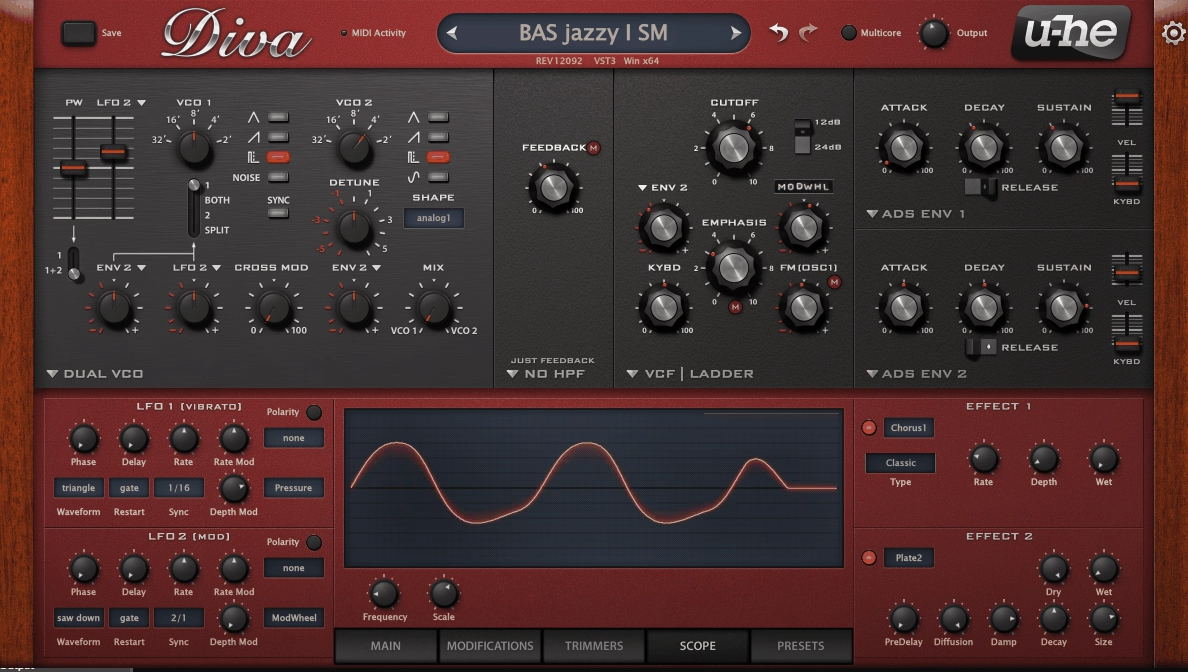
More than a decade after its release, u-he Diva still occupies a category of its own. Plenty of plugins emulate specific vintage synths with impressive accuracy. Diva does something fundamentally different: it gives you a toolkit of oscillator, filter and envelope modules sourced from across the history of analog synthesis and lets you snap them together into configurations that no real-world instrument has ever offered.
Want the raw VCO character associated with Moog designs running through a filter that responds like the Roland IR3109 chip, shaped by envelopes borrowed from the Jupiter family? That’s a few clicks in Diva. Oscillator sections draw on Moog, Roland Juno and Jupiter lineages plus a JP-8000-inspired digital module, while filter selections span Moog ladder circuits, Korg35 designs, and several other classic topologies.
The underlying technology is what earns Diva its reputation among working producers. Zero-delay feedback algorithms process filter behaviour in real time, capturing the way analog circuits respond to self-oscillation and resonance with a fidelity that conventional modelling methods fall short of.
The difference becomes obvious when you sweep a filter slowly through its range and hear the same organic movement and subtle pitch fluctuations that characterise actual hardware.
Your CPU will notice. Diva at maximum quality settings is resource-intensive by any standard, and dense arrangements may require compromises. Selectable rendering quality and multicore distribution ease the burden, and many users compose at reduced settings before bouncing at full resolution. 1,200+ presets cover a staggering breadth of analog territory, from squelchy acid bass to sprawling atmospheric pads, and the consistent quality throughout that library is genuinely impressive.
4. Moog Mariana
- Compatibility: Windows/macOS
- Format: VST3/AU/AAX
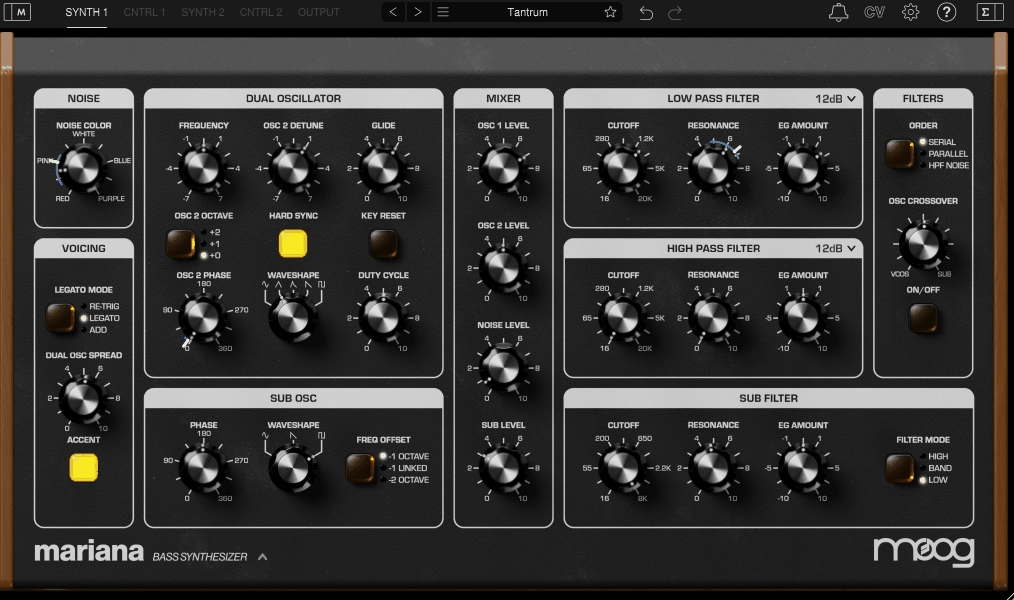
Moog Mariana is the instrument Moog designed for people who want more than a digital copy of a Minimoog. Named after the deepest ocean trench on the planet, it was conceived as a purpose-built bass synthesizer that channels the heritage of the Minimoog, Minitaur and Sub 37 into something that has no direct hardware equivalent.
The architecture is dual-layered, with each layer containing its own pair of oscillators sharing a waveshape selector, a Duty Cycle control that applies wave-folding modulation beyond just square-wave pulse width, an independently pitched sub oscillator, and a multi-type noise source.
Where things get interesting is the filter section, which diverges from the well-known Moog ladder circuit to deliver a more aggressive resonance curve that holds onto its bass weight even when cranked into extreme territory. Monophonic operation with a switchable duophonic option keeps the focus tight.
Per-layer modulation resources are substantial. Three syncable LFOs with phase control, three envelope generators including a five-stage type with adjustable delay onset, and two random voltage generators cover a huge range of movement and texture. Moog’s virtual CV system connects Mariana to other Moog plugin instances, including the Moogerfooger effects range, enabling modular-style patching between separate instruments within your session. Route an LFO to the MoogerFooger delay’s feedback, or bring external modulation into Mariana’s filter — it’s a brilliantly creative implementation.
Per-layer saturation covers tube, tape and overdrive flavours, with a compressor featuring an optional FET circuit rounding things off at the output stage. 200 factory presets span cinematic textures, sub-heavy bass patches, rhythmic sequences and experimental percussion. Be prepared for a noticeable CPU footprint, particularly with dual layers fully engaged.
5. Softube Model 72
- Compatibility: Windows/macOS
- Format: VST/VST3/AU/AAX
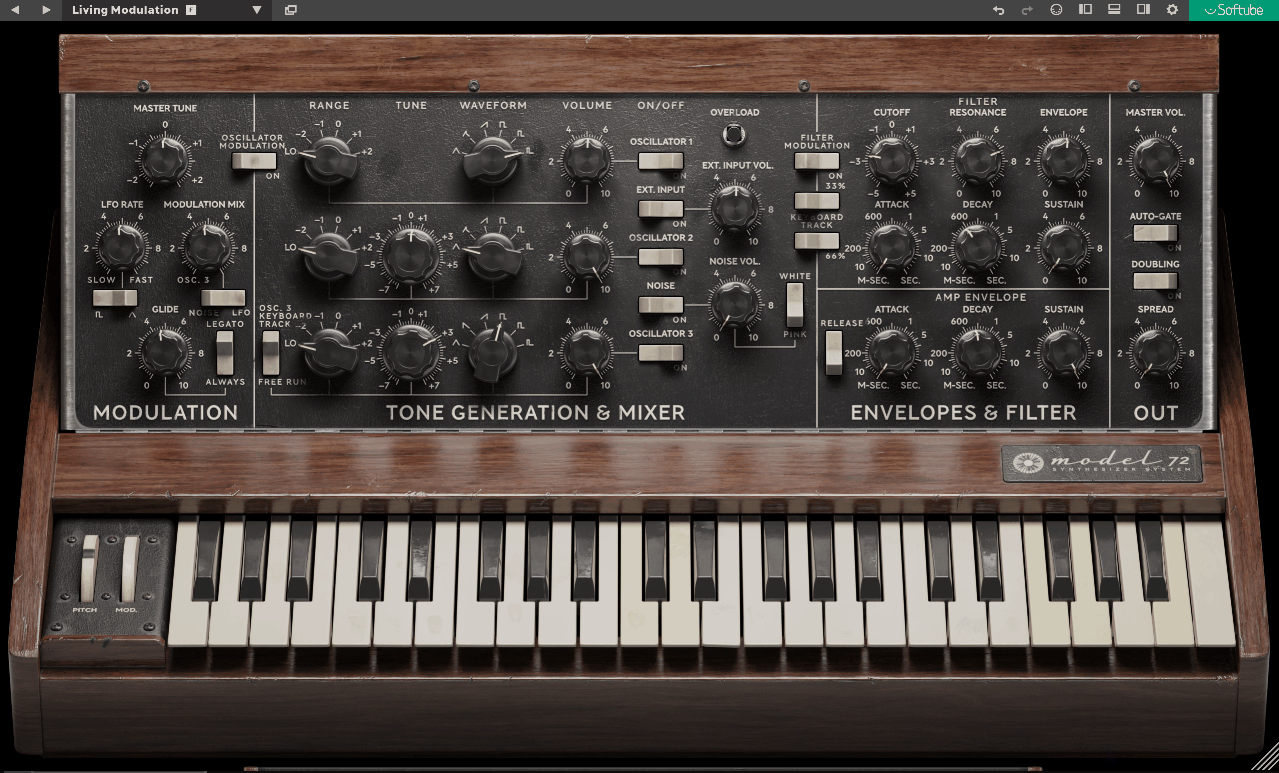
Every Minimoog that rolled off the production line between 1970 and 1981 sounded slightly different from the next, because hand-selected components and manufacturing tolerances meant no two units were truly identical. Softube Model 72 takes one particular September 1972 unit as its sole reference point, and the modelling captures not just that instrument’s intended functionality but its specific tolerances, drift characteristics and component ageing.
Softube’s background in professional audio emulation work for SSL, Tube-Tech, Chandler Limited and Weiss Engineering over nearly two decades means their component-level modelling is among the most rigorous in the industry.
Forum discussions comparing the Model 72 to actual Minimoog hardware frequently note how convincingly it handles envelope transitions and the way the filter overdrives when pushed hard, areas where less detailed recreations tend to fall short.
Beyond the synthesizer plugin itself, you receive three additional components. An FX version processes external audio through the Minimoog’s legendary filter and preamp stages, useful for adding analog colouring to drum loops or vocals.
An envelope filter module integrates with Softube Amp Room, and seven individual synthesis modules can be loaded into Softube Modular, where they can be combined with third-party Eurorack-style components for experimental patching.
The Minimoog’s famous output-to-input feedback trick, which generates thick, harmonically complex tones, works exactly as expected. Softube’s additions to the classic design include a doubler for stereo width, a spread parameter, and an expression panel offering velocity sensitivity and oscillator tuning refinements. Polyphony isn’t available — this is a monophonic instrument through and through — but the depth of the circuit modelling makes each single note count.
6. UAD Moog Minimoog
- Compatibility: Windows/macOS
- Format: VST3/AU/AAX (UAD Native and Apollo/UAD-2)
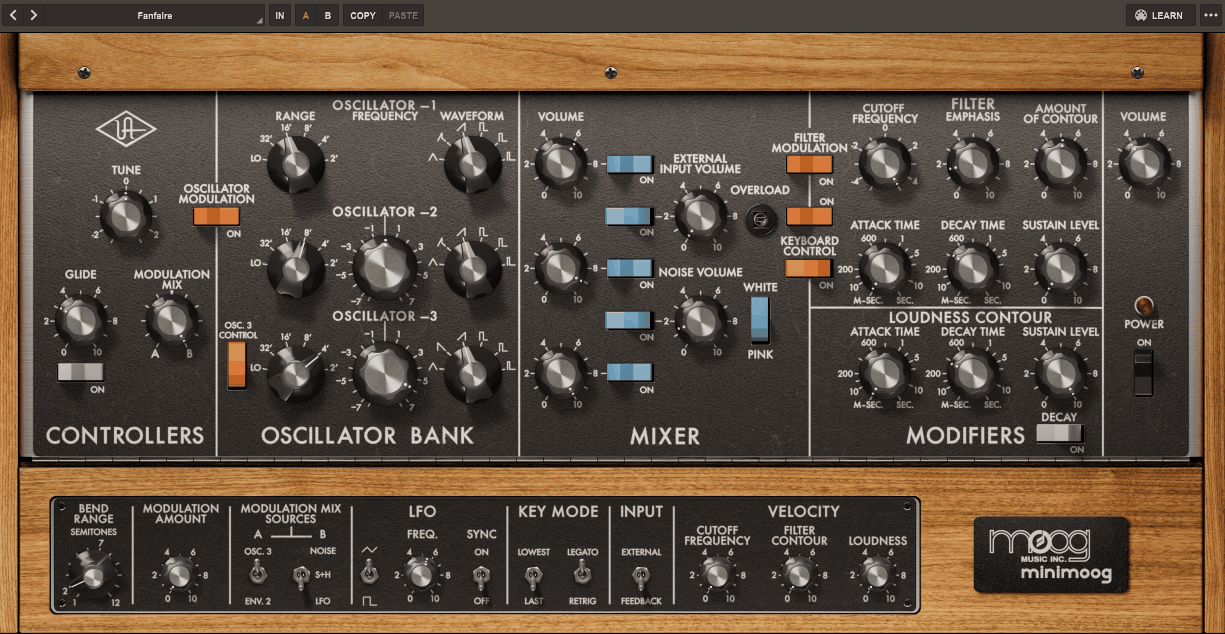
This plugin carries unique credentials. It’s the product of a formal collaboration between Universal Audio and Moog Music, making the UAD Moog Minimoog the only software emulation built under Moog’s direct supervision with access to their proprietary knowledge of the original circuits.
UA’s methodology for this project was unusually thorough even by their standards. Three vintage Minimoogs were evaluated through extensive listening sessions before a single reference instrument, dubbed the “Golden Unit,” was chosen. Automated robotic rigs then swept every control across its entire range, capturing response data with precision that surpasses anything achievable through manual measurement. The resulting model replicates how modules load each other electrically, how impedance varies across the signal chain, the way oscillators drift as temperature fluctuates, and the rich distortion produced when output is looped back through the external input.
A supplementary controls section brings commonly requested hardware modifications into the software. Note priority switching, legato triggering options, a dedicated additional LFO, sample-and-hold functionality, and velocity mapping to filter frequency, envelope intensity or volume all appear here. Crucially, every one of these additions can be individually bypassed, returning the instrument to authentic stock Minimoog behaviour.
Mac and Windows users can run the Native version without any UA hardware at all. DSP-accelerated variants are available for Apollo and UAD-2 owners who need the lowest possible latency for real-time performance. The factory preset selection is modest but well curated, and the panel layout makes hands-on sound creation intuitive for anyone comfortable with subtractive synthesis fundamentals.
7. Cherry Audio Mercury-8
- Compatibility: Windows/macOS
- Format: VST/VST3/AU/AAX
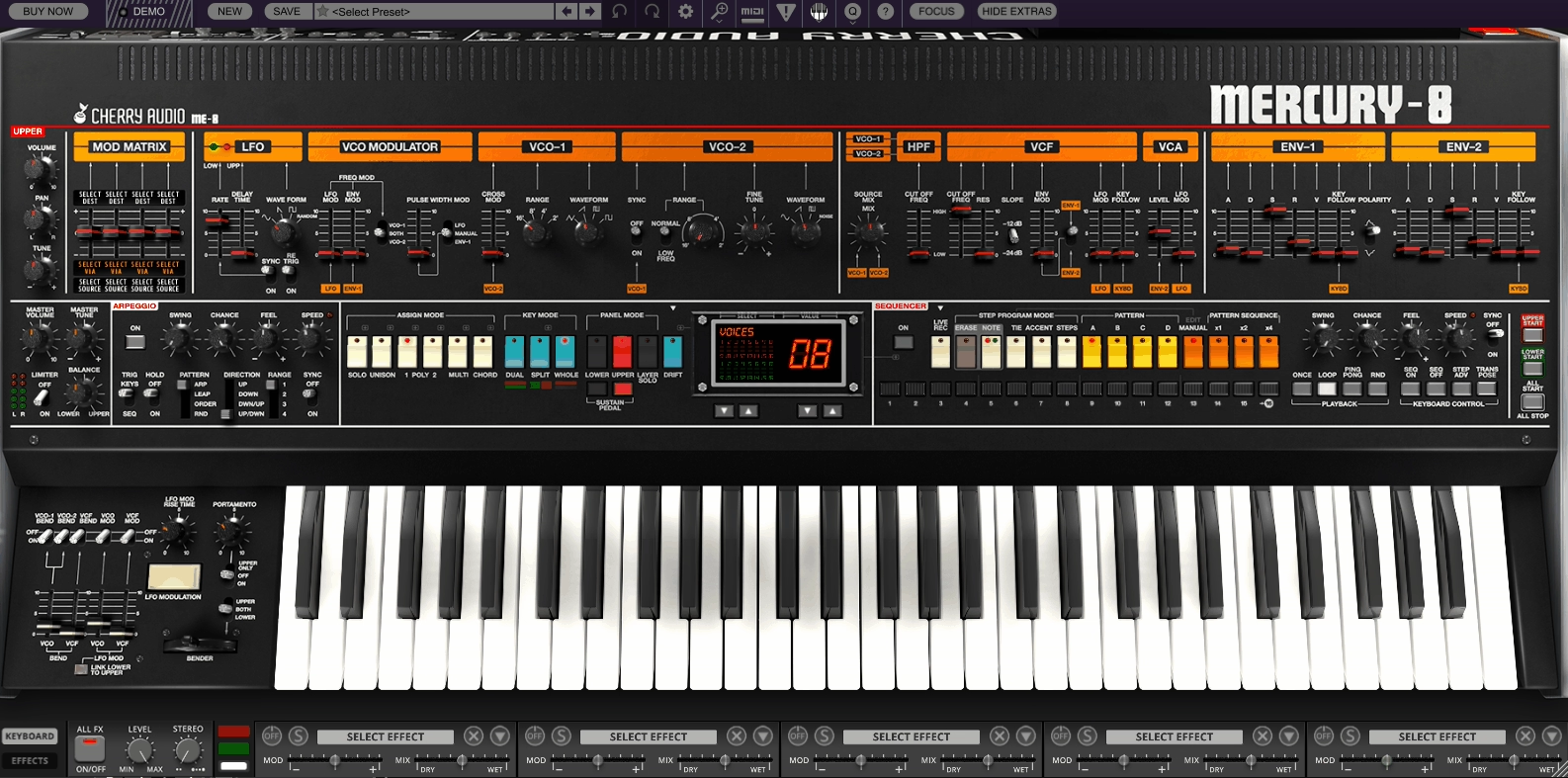
The Roland Jupiter-8 defined an era of polyphonic synthesis in the early 1980s, and originals now command prices that put them beyond casual ownership. Cherry Audio Mercury-8 approaches the challenge of recreating this legendary instrument not as a strict preservation exercise but as an opportunity to build the synthesizer the Jupiter-8 might have become if Roland had kept developing it for another forty years.
Cherry Audio worked from a fully calibrated original unit, using virtual analog modelling rather than sample-based methods so that every knob responds dynamically rather than stepping through pre-captured snapshots. Where the hardware offered eight voices across two layers, the Mercury-8 provides 16 per layer with split and stacked configurations that maintain full polyphony regardless of mode. Controls for analog drift and component aging let you tune the virtual circuitry from pristine to battle-scarred, affecting pitch stability, filter response and voice behaviour across the entire instrument.
Faithful recreations of the Jupiter-8’s high-pass and resonant low-pass filters are present with both 12dB and 24dB slope options, and playback modes including Solo, Unison, Poly and chord memory expand performance flexibility. Multi-voice trimmers introduce per-voice variation in pitch, filter, panning and other parameters, lending the kind of organic movement that eight identical digital voices simply cannot produce.
The effects engine is where Cherry Audio pushed furthest beyond the original specification. Each layer receives its own dedicated four-slot effects chain with 20 available processors, and a global chain adds another four slots on top. Highlights include a DCO Chorus circuit-modelled on the celebrated Roland Juno chorus, alongside reverbs, delays, distortion and filter effects.
A modulation matrix spanning 25 sources and 43 destinations, syncable arpeggiators per layer, and a 16-step polyphonic sequencer per layer.
8. E-Phonic Invader 2
- Compatibility: Windows/macOS
- Format: VST3/AU
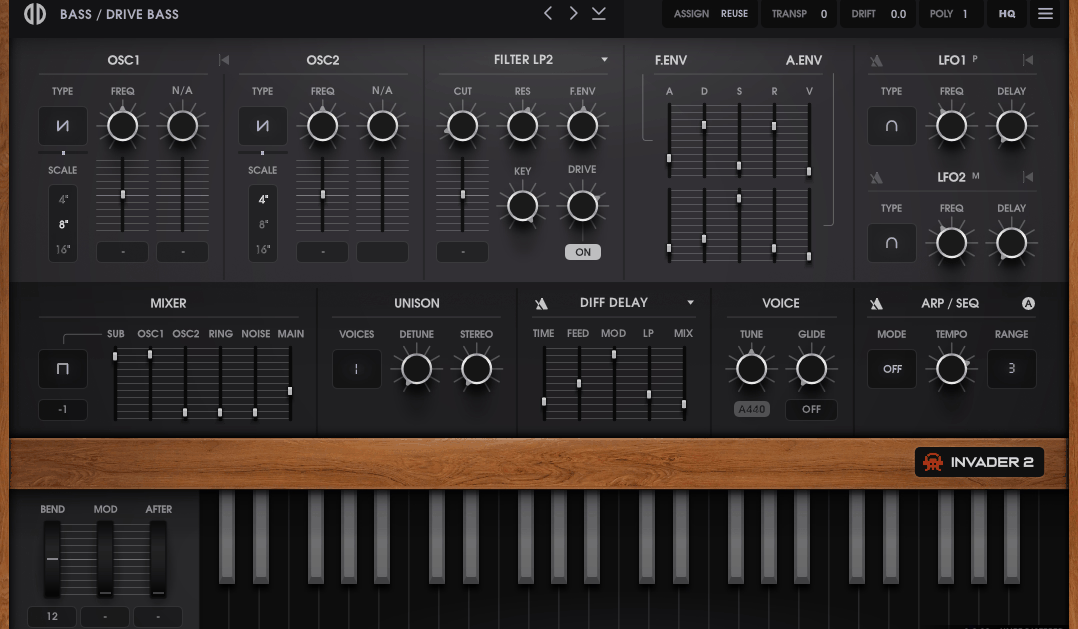
You don’t always need a deep feature list or a famous brand name to make good music. E-Phonic Invader 2 demonstrates that a small, focused development team with clear design priorities can produce an analog-modelling synth that sounds better than its minimal asking price would ever suggest.
E-Phonic previously released the Drumatic 4 drum synthesizer, and that same ethos of clean design paired with quality sound carries over here. Eight polyphonic voices. Every control visible at once on a single-panel interface. No hidden pages, no sub-menus.
Oscillator options across triangle, saw, pulse width, sync pulse, sync saw and saw-to-pulse shapes, combined with a dedicated sub oscillator, feed into three filter modes: clean low-pass, raw low-pass for added grit, and band-pass. A drive circuit and switchable high-pass round out the tonal shaping without adding clutter.
Voice count scales up to 48 through polyphonic stereo unison, and a dedicated low-CPU emulation mode achieves comparable width when full unison processing is more than your system can spare. Stereo noise and ring modulation contribute textural complexity, while two envelopes and two LFOs with onset delay cover modulation.
A built-in arpeggiator pulling double duty as a 16-step sequencer handles pattern creation, and four delay types spanning normal, ping-pong, tape and diffusion take care of spatial effects.
User ratings on KVR average near-perfect scores across multiple reviews, with the recurring praise centring on how refined and musical the oscillators sound given the lightweight nature of the instrument. Invader 2 doesn’t set out to compete with the heavy-hitters on modelling depth or feature breadth, and it doesn’t need to. As an immediate, great-sounding analog voice that respects both your workflow and your budget, it fills a gap that more ambitious plugins often overlook.
Hello, this blog is about more than just chorus, bass and synths. In fact, I started it to cover best VST plugins and Kontakt libraries, so you have easier time finding the right tools and instruments for your music production needs, mixing, as well as mastering. New tools and instruments are constantly evolving and need to get in front of audience, because even some of the best brands like Antelope Audio aren’t talked about enough – that’s what I want to change. I want to promote plugins that are less known but are perfectly relevant for certain topics.