
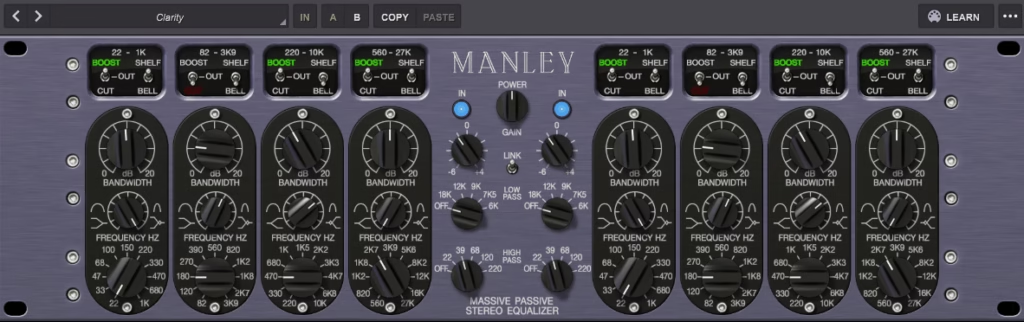
Walk into any high-end mastering studio and you’ll almost certainly find a passive equalizer sitting at the heart of the signal chain. These processors work differently from every other EQ type: the filter circuits contain no amplification at all, relying entirely on passive electronic components to sculpt the frequency spectrum while a dedicated amplifier stage handles the job of restoring lost signal level.
It’s an approach that rewards bold moves. Boost heavily on a passive EQ and the result stays smooth, musical and usable in ways that would sound harsh or clinical through most active alternatives.
The story starts with the Pultec EQP-1A in the early 1950s, a deceptively simple two-band equalizer that established many of the principles passive EQ designers still follow today. Its signature technique involves boosting and attenuating the same bass frequency simultaneously, which produces a distinctive resonant lift with a controlled dip sitting just above it, perfect for adding low-end size without sacrificing definition. That trick alone has appeared on more hit records than anyone could reasonably count, and modern engineers continue reaching for it daily.
In the decades since, companies including Manley, SPL and Bettermaker have taken passive EQ architecture far beyond what the original Pultec could achieve, building units with more frequency bands, parallel topologies and extended range.
Plugin developers have pushed even further, adding features that would be physically impossible in analog hardware: linear phase processing, built-in spectrum analysis, mid/side encoding, and per-component tolerance variation that makes each channel behave like a slightly different piece of equipment. A number of genuinely excellent passive EQ plugins are also entirely free, removing any financial barrier to experiencing what this approach can do for your mixes.
We put each of these through real-world sessions to compile a list of 12 passive EQ plugins that hold up under serious use.
1. Slate Digital SD-PE1
- Compatibility: Windows/macOS
- Format: VST2/VST3/AU/AAX
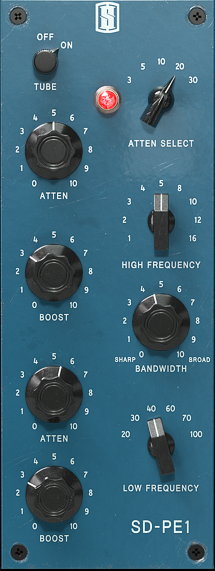
Among the dozens of Pultec EQP-1A recreations floating around the plugin market, Slate Digital SD-PE1 carves out its own space by meaningfully extending the frequency range in both directions. It loads as a module within the Virtual Mix Rack plugin host, stacking neatly alongside other VMR processors in one window.
Sub-bass frequencies the vintage hardware couldn’t touch are now available at 40Hz and 70Hz on the low shelf, and the high shelf options push up to 30kHz while adding a 3kHz position for upper midrange work. Extra bell filter points at 1kHz and 2kHz fill another gap in the original design. For anyone mixing contemporary bass-heavy genres, these additions transform the SD-PE1 from a nostalgic emulation into a genuinely modern production tool.
Two features make the day-to-day experience noticeably better than a standard Pultec clone. Frequency selectors toggle between traditional stepped detents and a free continuous sweep, giving you both recall accuracy and fine-resolution tuning in the same control. And the tube saturation stage, normally baked into every Pultec design as a permanent part of the output path, can be switched off entirely here while the plugin automatically maintains your output level. That means transparent, saturation-free passive EQ curves are just one click away when you need them. Naturally, the classic low-end boost/cut trick works exactly as expected, delivering that trademark resonant punch on kick drums and bass instruments.
2. Pulsar MP-EQ
- Compatibility: Windows/macOS
- Format: VST2/VST3/AU/AAX
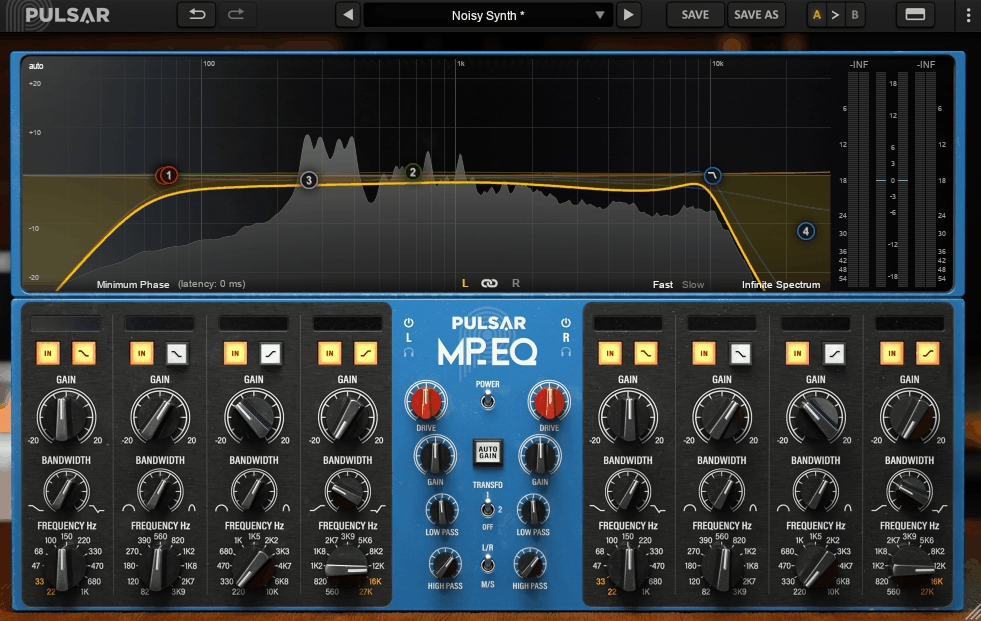
Manley’s Massive Passive hardware routes its four passive bands in parallel rather than series, which fundamentally changes how stacked boosts behave. The result sounds huge without the frequency buildup problems that serial architectures produce. Pulsar MP-EQ models every element of that design individually, from inductor response curves to vacuum tube saturation behaviour, building the complete circuit from the ground up.
The feature that separates this from every competing Massive Passive emulation is an optional linear phase engine that recombines all frequencies in perfect alignment after the EQ processing, eliminating the phase shifts that passive analog circuits inherently create. In mastering environments and genres where transient accuracy and stereo precision are critical, that capability bridges the gap between vintage warmth and clinical transparency.
Two interface layouts work in tandem: a faithful hardware panel with rotary controls and a parametric-style node editor with live spectral display, both active at the same time if you choose. A Drive knob sets the tube saturation intensity. Two switchable transformer models deliver different harmonic textures. Channels split for independent stereo or mid/side operation, and automatic gain matching keeps volume consistent as you shape the signal. Despite modelling an extraordinarily complex analog circuit, the plugin runs lean on CPU.
3. Knif Audio Soma
- Compatibility: Windows/macOS
- Format: VST2/VST3/AU/AAX
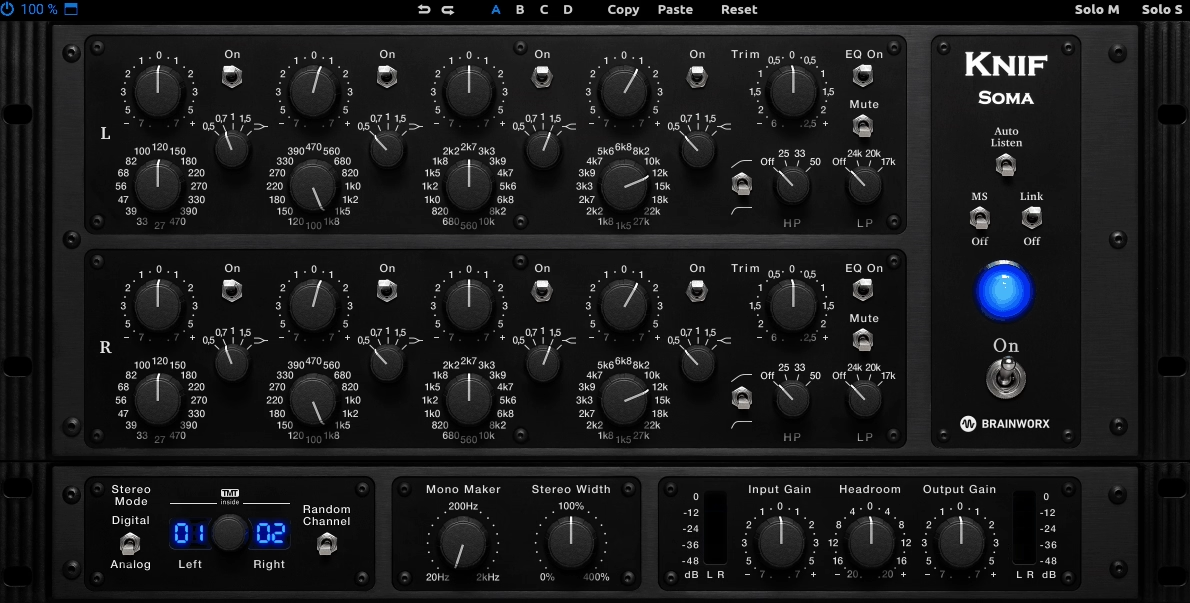
Every engineer who has worked extensively with passive EQ hardware knows the annoyance: adjust the bandwidth and the gain shifts. Tighten the Q and suddenly your carefully set boost amount has moved. The Plugin Alliance Knif Audio Soma eliminates this problem entirely through a proprietary system called Real Q Adjustment, which isolates bandwidth and gain controls so that changing one has absolutely zero effect on the other.
That sounds like a subtle technical detail, but in practice it completely transforms the mastering workflow. Dialling in precise adjustments happens in a single pass rather than the iterative back-and-forth that conventional passive EQs demand. Finnish designer Jonte Knif originally built this for his own hardware, and the Brainworx-modelled plugin version preserves the innovation perfectly.
Tonally, this occupies a distinctly different corner of the passive EQ world. Rather than the saturated, coloured warmth associated with Pultec or Massive Passive designs, the Soma presents a notably transparent and neutral starting point. Harmonic richness only appears when you intentionally engage the Headroom and Drive stages. Four parametric bands span the full spectrum with 0.5dB gain resolution below 3dB and 1dB steps above. Brainworx layers on TMT (Tolerance Modeling Technology) for realistic analog channel variation, Auto Listen for soloed EQ audition, Mono Maker to tighten stereo bass content, and complete mid/side processing across every band.
4. Harris Doyle Natalus DSCEQ
- Compatibility: Windows/macOS
- Format: VST2/VST3/AU/AAX
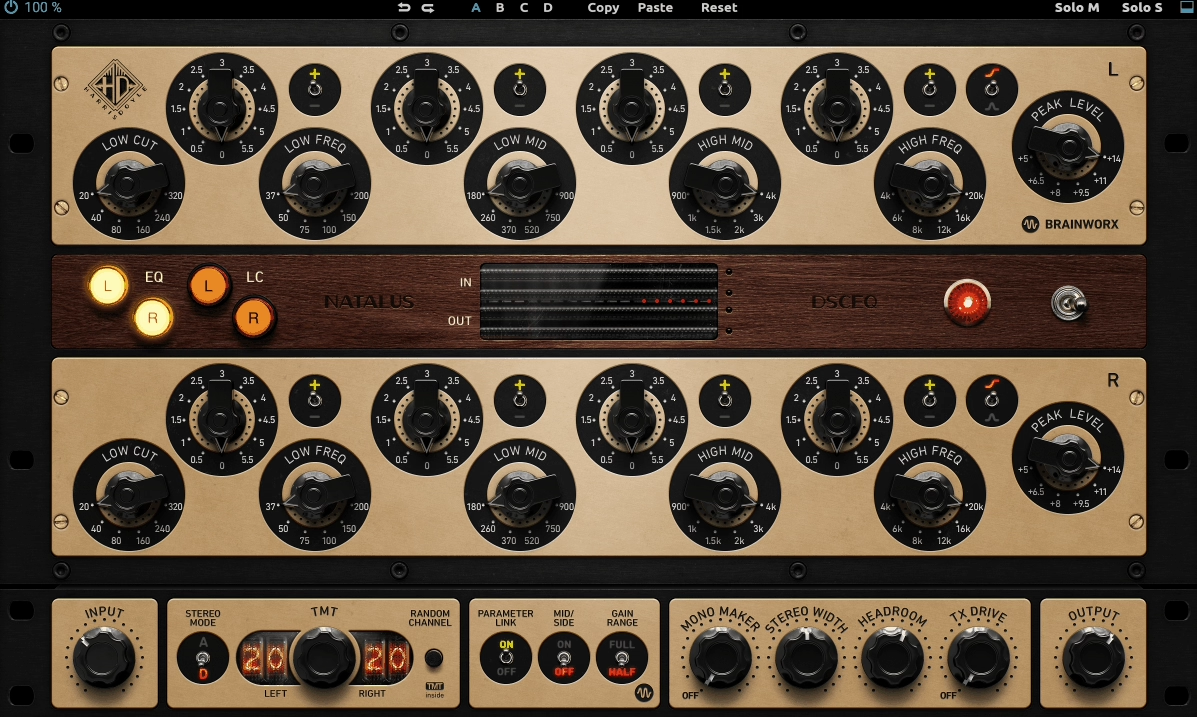
What happens when you feed audio through a magnetically saturating transformer and use that saturation to control transient peaks instead of a traditional compressor circuit? That’s the question at the centre of the Harris Doyle Natalus DSCEQ, a four-band passive inductor equalizer with an integrated dynamics feature called Peak Level that exists nowhere else in the plugin world.
The Peak Level control operates on a fundamentally different principle from gain-reduction-based compression. As signal peaks hit the transformer core, the magnetic material saturates progressively, naturally rounding transients with a dense, tape-like quality while leaving the body and sustain of the sound completely untouched. One knob. No threshold. No ratio. No timing parameters. Just organic, musically responsive peak management that fattens audio without flattening it. Rod Harris and Govinda Doyle designed this behaviour into the original handcrafted Australian hardware, and Brainworx captured it with meticulous accuracy.
The equalizer section uses broad, forgiving curves across four overlapping bands with 11dB of travel per control, feeding through a Class A output amplifier with transformer-balanced connections. You can push these bands hard and the results stay musical. Brainworx extras include TMT channel variance modelling, TX Drive for transformer saturation control, stereo width and mid/side processing, and a purpose-built mono plugin version for channel strip duties on individual sources.
5. D16 Group Pulsatec
- Compatibility: Windows/macOS
- Format: VST2/VST3/AU/AAX
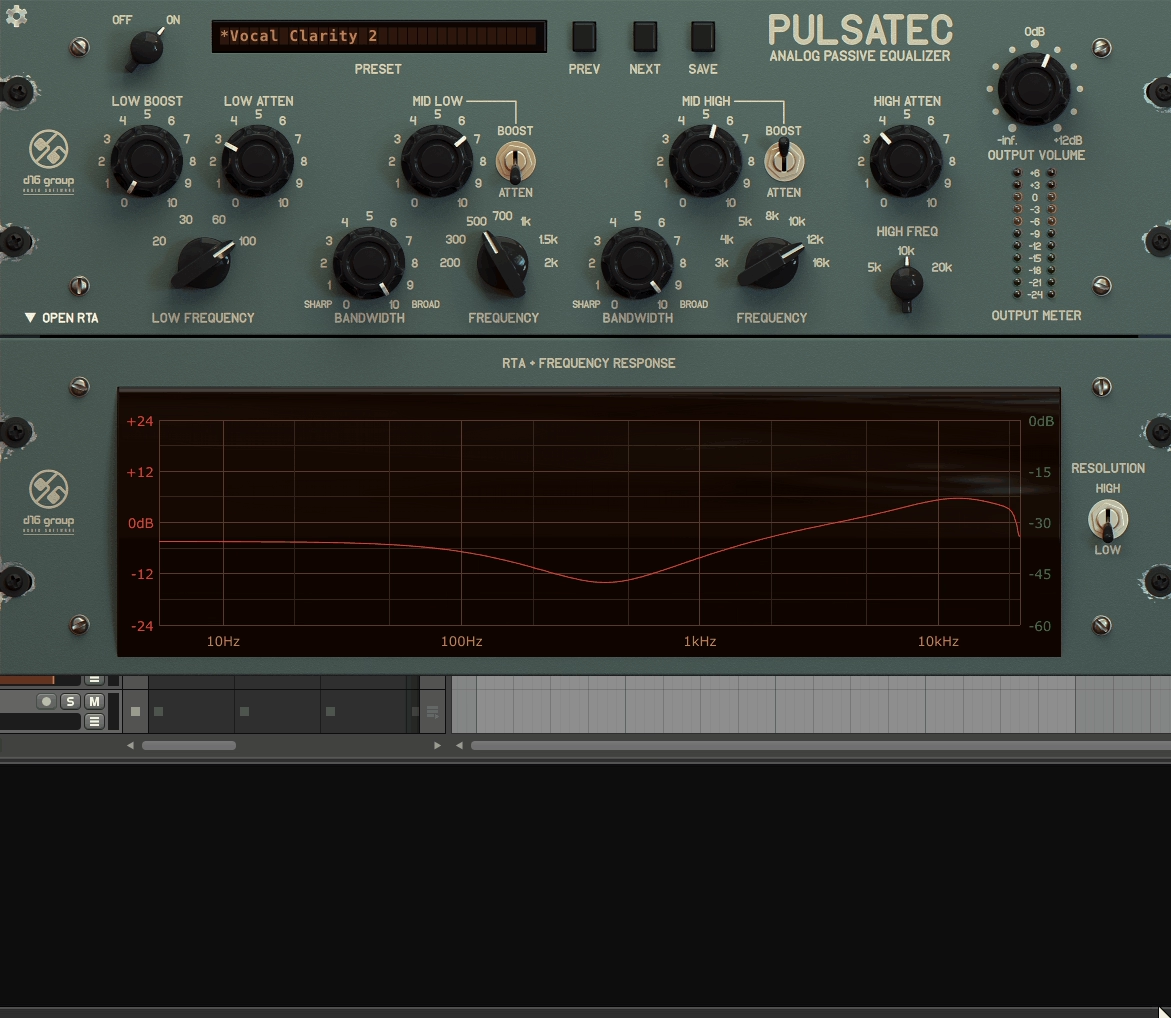
The EQP-1A is a brilliant EQ with one obvious limitation: there’s essentially nothing happening in the midrange. D16 Group Pulsatec addresses that head-on. Rather than faithfully cloning the original’s two-band layout and calling it a day, D16 designed two dedicated mid-frequency bands into the architecture, turning a classic low-and-high passive EQ into a four-band tool with proper full-spectrum coverage.
The low band keeps its traditional simultaneous boost/attenuation design at 20, 30, 60 and 100Hz. The additions sit above: a low-mid covering 200Hz to 2kHz across seven positions, and a high-mid spanning 3kHz to 16kHz, both with variable bandwidth and boost/cut switching. A separate high-frequency attenuation section at 5, 10 and 20kHz handles top-end roll-off.
For many users, though, the most immediately valuable feature will be the collapsible real-time spectrum analyser overlaid with your EQ curve, showing both input and output simultaneously. Passive EQ curves don’t always behave the way you’d expect from looking at the controls, and having that visual confirmation in real time is a genuine workflow accelerator during mix sessions.
D16’s characteristically polished interface rounds things out with HiDPI support for sharp rendering on modern displays, MIDI Learn across all parameters, and output metering with per-band bypass.
6. Bettermaker Passive Equalizer
- Compatibility: Windows/macOS
- Format: VST2/VST3/AU/AAX

The hardware that inspired this plugin, Bettermaker’s Valve Stereo Passive Equalizer, uses NOS vacuum tubes, FET-input Burr-Brown amplifiers and custom TT-1 transformers in a circuit that Warsaw’s mastering community has trusted for years. Bettermaker Passive Equalizer brings all of that into software through detailed circuit modelling that goes well beyond simple curve approximation.
The interface offers a choice that most passive EQ plugins don’t. Traditional hardware-style knobs handle the expected boost/cut duties, but a parametric curve editor with integrated spectral display provides an entirely different way of interacting with the same underlying filter network. You can drag frequency nodes visually while the passive topology keeps the curves smooth and musical underneath. Having both available simultaneously lets you verify moves by ear through the knobs and by eye through the analyser without switching between views.
Low boost and low cut frequencies operate on independent selectors rather than being locked to a single shared frequency point, which gives significantly more flexibility when shaping the bottom end compared to a standard Pultec layout. The high-frequency boost range extends into air-band territory. An Audition function isolates individual bands for focused evaluation, over 50 professionally designed presets provide genre-spanning starting points, and dedicated mastering-quality HPF and LPF filters clean up the frequency extremes with precision.
7. SPL Passeq
- Compatibility: Windows/macOS
- Format: VST2/VST3/AU/AAX
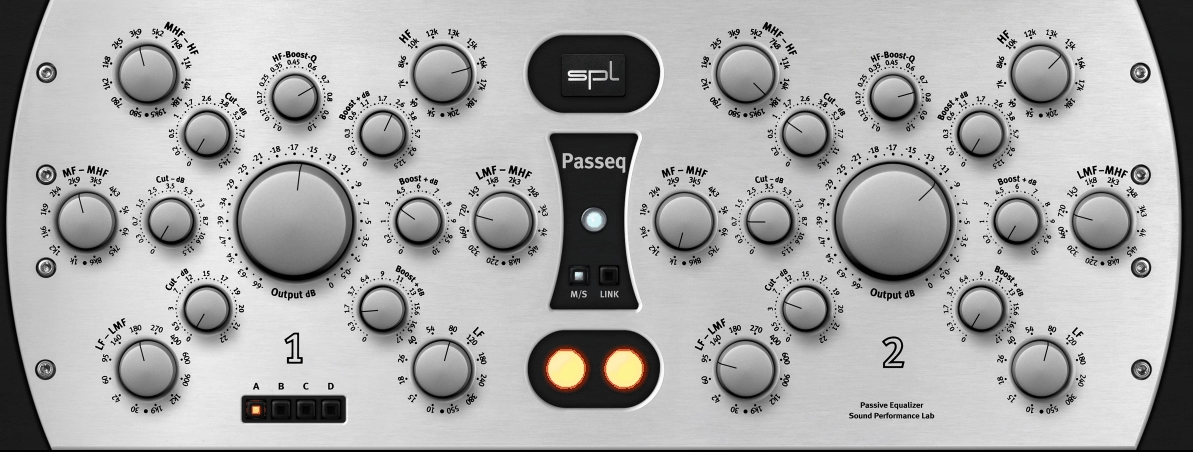
Seventy-two frequency targets per channel. That figure alone tells you the SPL Passeq operates on a different scale from anything else in the passive EQ category. Six bands provide 12 switchable frequencies each, and here’s the critical detail: the boost and cut frequency selections are deliberately different values, meaning the 36 boost targets and 36 cut targets never overlap, giving you access to twice as many frequency points as a shared-frequency design would allow.
The panel layout demands a moment of orientation. Attenuation filters occupy the left side, boosts the right, each spread across three frequency ranges. After that initial learning curve, the depth of control becomes addictive. Choosing separate frequencies for boost and cut on the same band enables complex sculpting, dipping at one point while lifting at an adjacent frequency, all through musically interactive passive curves.
This isn’t just a lot of bands thrown at a wall. The plugin’s component-level modelling faithfully recreates the interdependent filter behaviour of SPL’s 120V analog hardware, where every band’s response subtly shifts in reaction to adjustments made on every other band. That cross-talk between filters is the heart of what makes passive EQs sound distinctly different from parametric designs, and here it plays out across six bands rather than two. Upper frequency options extend to 25kHz and 35kHz for air-band work.
M/S and L/R processing modes, four A/B/C/D recall slots and a space-saving single-channel display keep the plugin practical despite its depth.
8. UAD Manley Massive Passive
- Compatibility: Windows/macOS
- Format: VST3/AU/AAX (UAD Native and Apollo/UAD-2)
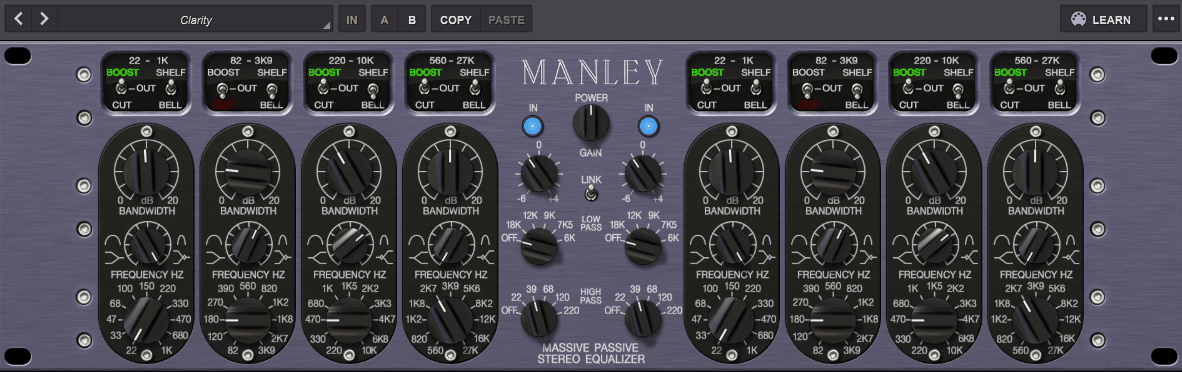
Universal Audio spent six months collaborating directly with the Manley Labs team to develop this plugin, with EveAnna Manley’s engineers providing actual hardware components for measurement. UAD Manley Massive Passive aims to reproduce not just the EQ curves but every piece of nonlinear analog behaviour that gives the hardware its character.
The modelling captures transformer saturation at varying drive levels, inductor hysteresis under changing magnetic conditions, and the progressively shifting harmonic profile of the tube gain stages as signal amplitude rises and falls. It’s the kind of deep, multi-layered emulation that explains why UA chose to spend half a year on a single product.
The Massive Passive hardware draws from multiple EQ design traditions, pulling together concepts from console equalizers, parametric processors and classic passive circuits into a four-band, two-channel format. Parallel signal architecture is the defining element: overlapping frequency boosts combine musically rather than stacking aggressively, which is what allows you to apply broad, generous enhancements across the spectrum without losing clarity. Every band switches between bell and shelf operation. Two plugin variants ship together: a Standard version with continuous bandwidth control and a Mastering version using 16 stepped positions with reduced gain ranges for tighter recall precision. The Native edition runs on any Mac or PC without UA hardware, and DSP-accelerated versions for Apollo and UAD-2 systems are included as well.
Extra: Waves Abbey Road RS56 Passive EQ
- Compatibility: Windows/macOS
- Format: VST/AU/AAX
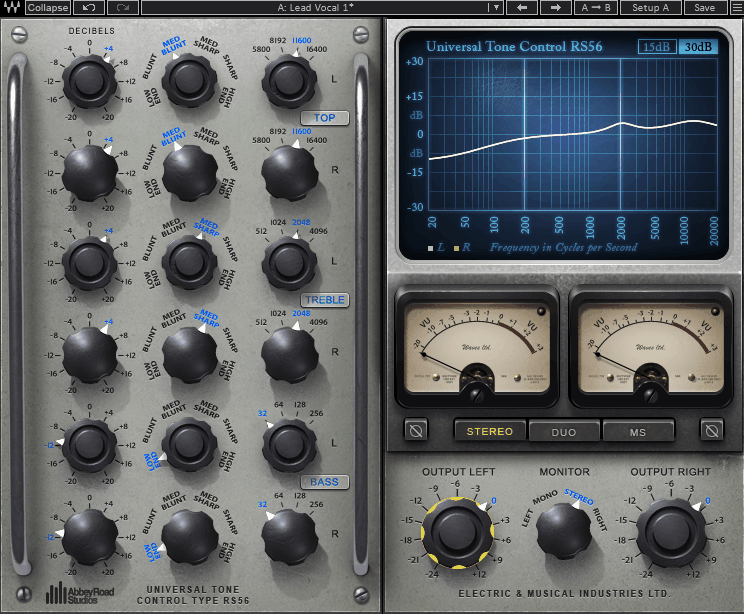
Originally designed as a utilitarian transfer EQ for Abbey Road’s disc-cutting rooms in the 1950s, the RS56 Universal Tone Control spent its early life preparing recordings for the vinyl lathe. Nothing glamorous. Everything changed when the studio’s pop engineers realised this three-band passive unit could shape frequency balance with a subtlety and musicality that their basic mixing console tone controls simply couldn’t match. They nicknamed it “The Curve Bender,” and from that point forward it found its way onto session after session, including recordings by the Beatles.
The Waves Abbey Road RS56 Passive EQ plugin was built from original Abbey Road circuit documentation. Four octave-spaced frequencies per band and six selectable filter types per band give what looks like a minimalist three-knob EQ a much broader palette than you’d initially expect. Bass options land at 32, 64, 128 and 256Hz; the middle section addresses 512 through 4096Hz; and the top band operates at half-octave intervals above those.
The software version dramatically improves on the hardware’s limited control resolution. The analog original restricted you to 10dB of gain adjustment in coarse 2dB increments, but Waves extended the range to 20dB with fine 0.1dB stepping, making the RS56 viable for precision mastering work that the hardware was never really designed for. Full stereo, dual-mono and mid/side operation is available alongside separate left/right channel adjustment, phase inversion, and calibratable VU metering. It’s a warm, unforced-sounding EQ that works particularly well on grouped drums, instrument submixes and stereo buses.
Freebies:
1. Analog Obsession MaxBax
- Compatibility: Windows/macOS
- Format: VST3/AU
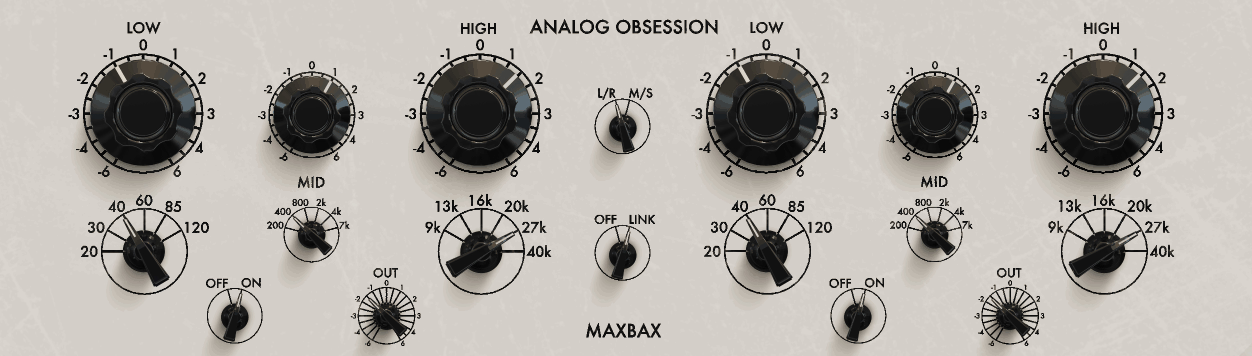
Solo developer Ridvan Kucuk has built a staggering free plugin catalogue under the Analog Obsession brand, and Analog Obsession MaxBax might be the most focused tool in the entire collection. It’s a Baxandall-topology passive equalizer with an additional mid band, aimed squarely at mastering and bus duties where precision and repeatability take priority over character.
Baxandall shelving curves are among the gentlest filter shapes in audio, producing extremely broad spectral tilts without the resonant peaks, dips or abrupt transitions that other topologies introduce. They’re tailor-made for the kind of overall tonal rebalancing that mastering demands.
Three bands with six stepped frequency positions each cover 20Hz to 120Hz on the lows, 200Hz through 7kHz in the mids, and 9kHz up to 40kHz on the highs. All gain controls and the output stage move in precise 0.5dB steps, providing the kind of careful, repeatable adjustment resolution that professional mastering sessions require. An LR/MS switch opens up dual-mono and mid/side processing, with a link option for standard stereo operation.
A handful of users have pointed out that the dark visual design makes some knob labels slightly difficult to read. It’s a minor cosmetic issue against what is otherwise one of the most competent free mastering EQs available anywhere.
2. Variety Of Sound FlavourMTC
- Compatibility: Windows only
- Format: VST/VST3 (32/64-bit)
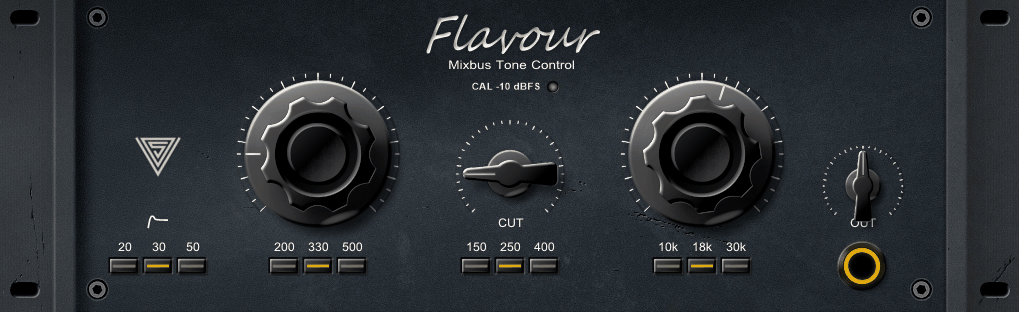
Herbert Sigmund’s Variety Of Sound project has been delivering studio-quality freeware since 2009. Variety Of Sound FlavourMTC, released in 2022, is a ground-up original design rather than a reissue of an older plugin. The abbreviation stands for Mixbus Tone Control, and it does exactly what that name suggests: it sits on your stereo bus or master channel and shapes the overall tonal balance.
True to passive EQ principles, the equalizer section contains no amplification circuitry, with all signal recovery handled by a dedicated output amp stage that doubles as an optional saturation engine. Engage it, calibrate it to your session’s operating level, and the amp introduces a warm “box tone” quality, an analog console-like cohesion that subtly binds the mix together. Disable the nonlinear processing entirely and CPU consumption drops by approximately two-thirds, leaving you with a completely transparent passive EQ.
Zero-delay feedback first-order shelving filters manage the high and low frequencies. A low-cut filter at 20, 30 or 50Hz clears subsonic content, and a cut-only bell at 150, 250 or 400Hz targets muddy midrange buildup. Internal oversampling maintains clean processing throughout.
The elephant in the room: this plugin is Windows-only, offered exclusively as VST and VST3, with no macOS version available. That’s a hard stop for a significant percentage of producers. For those on Windows, though, it’s difficult to argue with the quality. Sigmund’s track record speaks for itself, and FlavourMTC upholds his reputation for plugins that rival paid alternatives.
3. Ignite Amps PTEq-X
- Compatibility: Windows/macOS
- Format: VST/VST3/AU/AAX
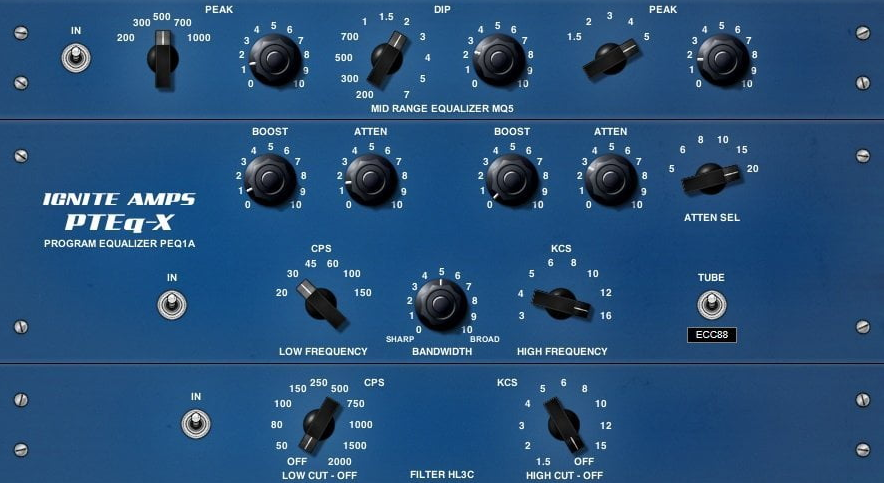
You don’t typically expect a company known for devastating metal amp simulations to produce a refined passive program equalizer, but that’s exactly what Ignite Amps did. Ignite Amps PTEq-X packages faithful emulations of three separate vintage passive EQ processors within a single window: the PEQ-1A handles broadband tonal shaping, the MQ5 targets midrange frequencies specifically, and the HL3C provides precision high and low filtering. Three hardware rack units condensed into one free download.
Ignite’s third-generation triode modelling powers the tube saturation stage, offering four switchable valve types with distinct harmonic profiles ranging from clean and subtle to warm and saturated. Drive the input harder and harmonics build progressively; keep input levels moderate and the tubes stay quiet. Additional frequency selections on the PEQ-1A go beyond the original Pultec’s options, and refined filter precision on the MQ5 and HL3C corrects some of the compromises present in the vintage originals.
A toggleable linear-phase oversampling mode reduces digital artefacts when maximum quality matters. Processing runs at 64-bit double precision throughout, full parameter automation is supported, and a built-in preset management system with bank export and import keeps sessions organised.
Forum feedback across KVR and Gearspace consistently praises PTEq-X as a plugin that competes credibly against paid Pultec emulations costing many times more. The low-end boost/cut interaction delivers authentic weight, the tube options provide meaningful tonal variety, and the integrated midrange section fills the frequency gap that single-unit Pultec plugins always leave empty. For anyone who hasn’t explored passive EQ yet, starting here costs nothing and delivers a remarkably complete introduction to what the topology can do.
Hello, this blog is about more than just chorus, bass and synths. In fact, I started it to cover best VST plugins and Kontakt libraries, so you have easier time finding the right tools and instruments for your music production needs, mixing, as well as mastering. New tools and instruments are constantly evolving and need to get in front of audience, because even some of the best brands like Antelope Audio aren’t talked about enough – that’s what I want to change. I want to promote plugins that are less known but are perfectly relevant for certain topics.